Keeping an eye on monkeys keeping an eye on monkeys

It’s easy keeping an eye on the monkeys because I cycle past Don Chao Poo and Don Jik every day. I sometimes get to Don Jik before the monkeys have come down from the trees, but more often when I get to the bridge there are at least a few of them there. One day I counted 20 of them but usually I only see about half that number. In Don Chao Poo there are 400, 500, 600 perhaps, and the sheer size of that colony may be why my visits to Don Jik often reveal more intimate moments.

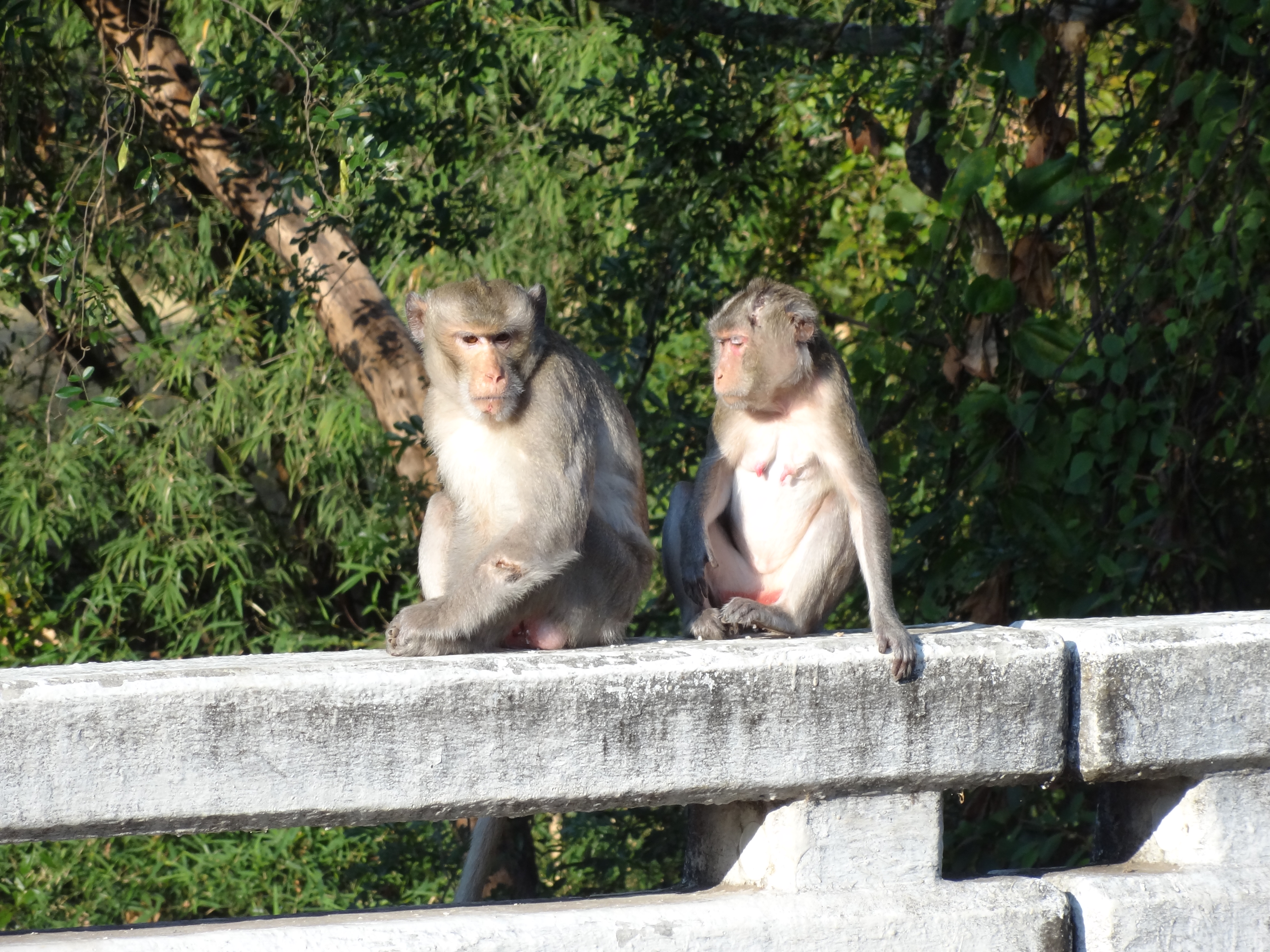
One recent morning I got to Don Jik just in time to see a large male crossing the road at the bridge. He was crossing from the north to the south, and went down to the flat, sandy clearing where a farmer (who was absent) has a hut, a bag of stones and a catapault. Within minutes of his arrival on the south side, an almighty uproar broke out. Momentarily I thought he had been attacked by a dog, and I continued to think so as more and more monkeys came down from the trees, all making loud, angry growling sort of noises. I couldn’t see any action but could hear it well enough, and a few moments later that same large male came back up onto the road, chased by other monkeys. They saw him off across the road and into the riverside trees. They didn’t follow him, but gathered in a group on the bridge.

They were joined by all the other monkeys, all of them coming from the trees on the south side. They  gathered on the roadside and it was easy to count them: males, females, young adults, juveniles, infants: 20 of them in total. This was the first time I had seen all of them together at the same time, although I had counted 20 before, as they slowly emerged from the forest. It was pretty clear that they were all aware of the nature of this event: a crisis for the group, and they had responded as a group and were staying together in group solidarity.

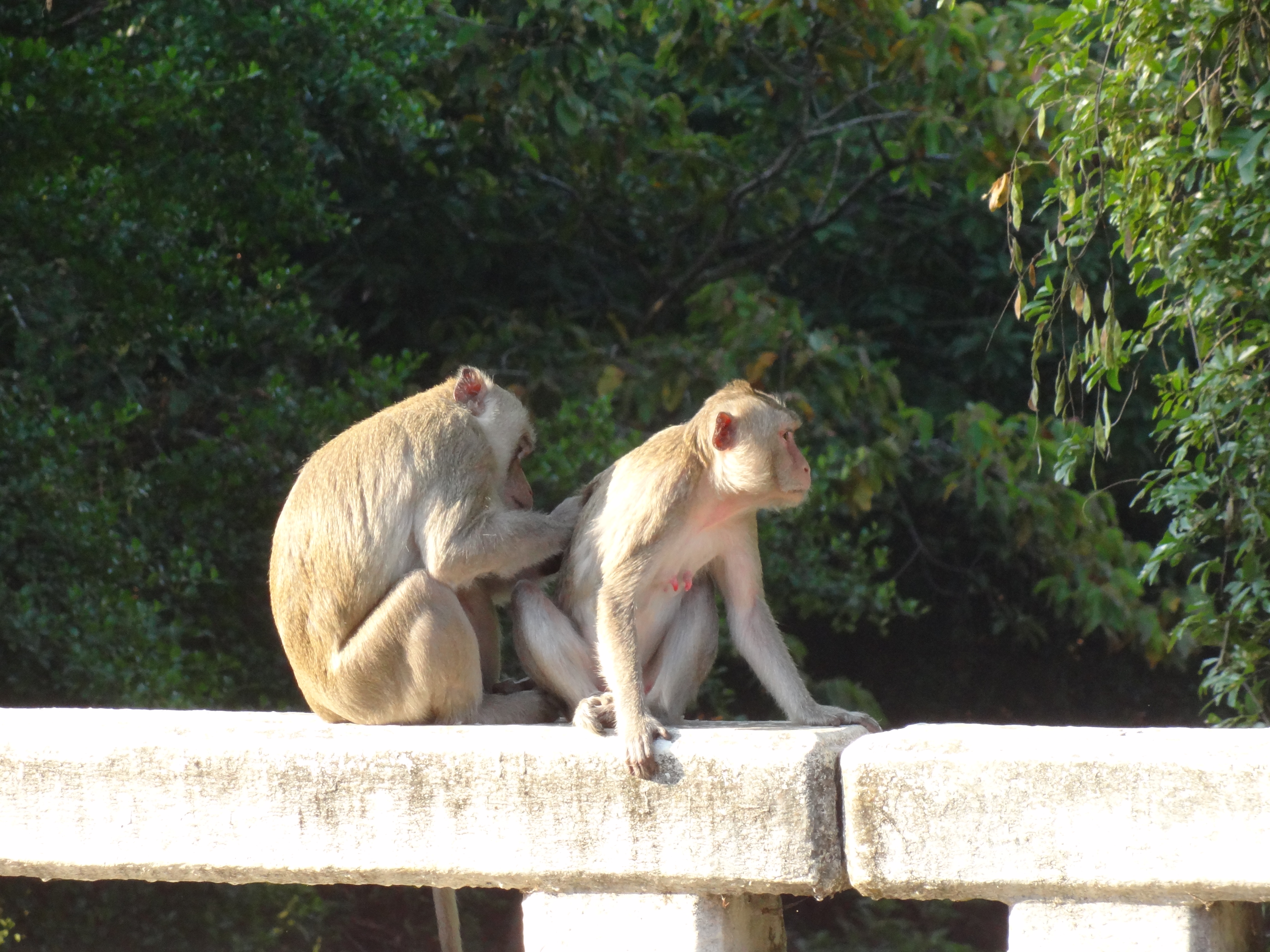
I didn’t use my camera that day out of respect for their nervous and excitable condition, but a couple of days later I did catch the alpha male with one of his older female mates in a touching little scene that said a lot about what had gone on.

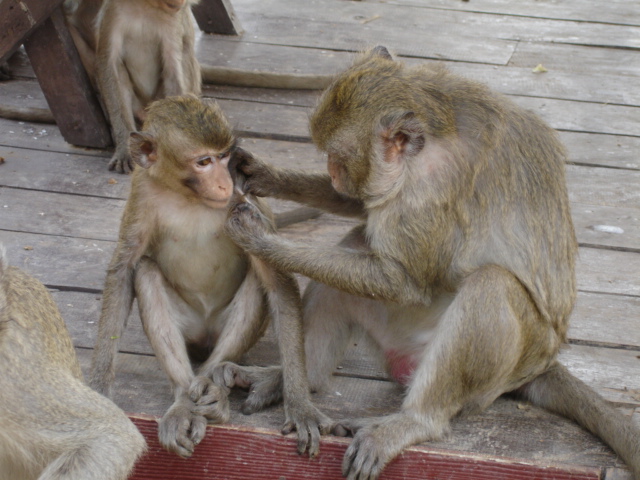
Click to enlarge the picture. You will notice that the female is attending to a gash on the male’s back, while she herself seems to have suffered a loss of hair on top of her head.

Now she has noticed that he also has an injury to his left forearm:

“I’ll take a look at that for you, dear,” she murmurs (sorry about the anthropomorphism!), and she does.

He is being very stoical about it all, isn’t he? If you enlarge this photo you will see more clearly the injury similar to his on the top of her head, which suggests that she played a full part in the scrap when the colony was invaded. She may even have been the focus of it. Anyway, the old male seems very appreciative of the attention he has received and repays her with a bit of gentle grooming.

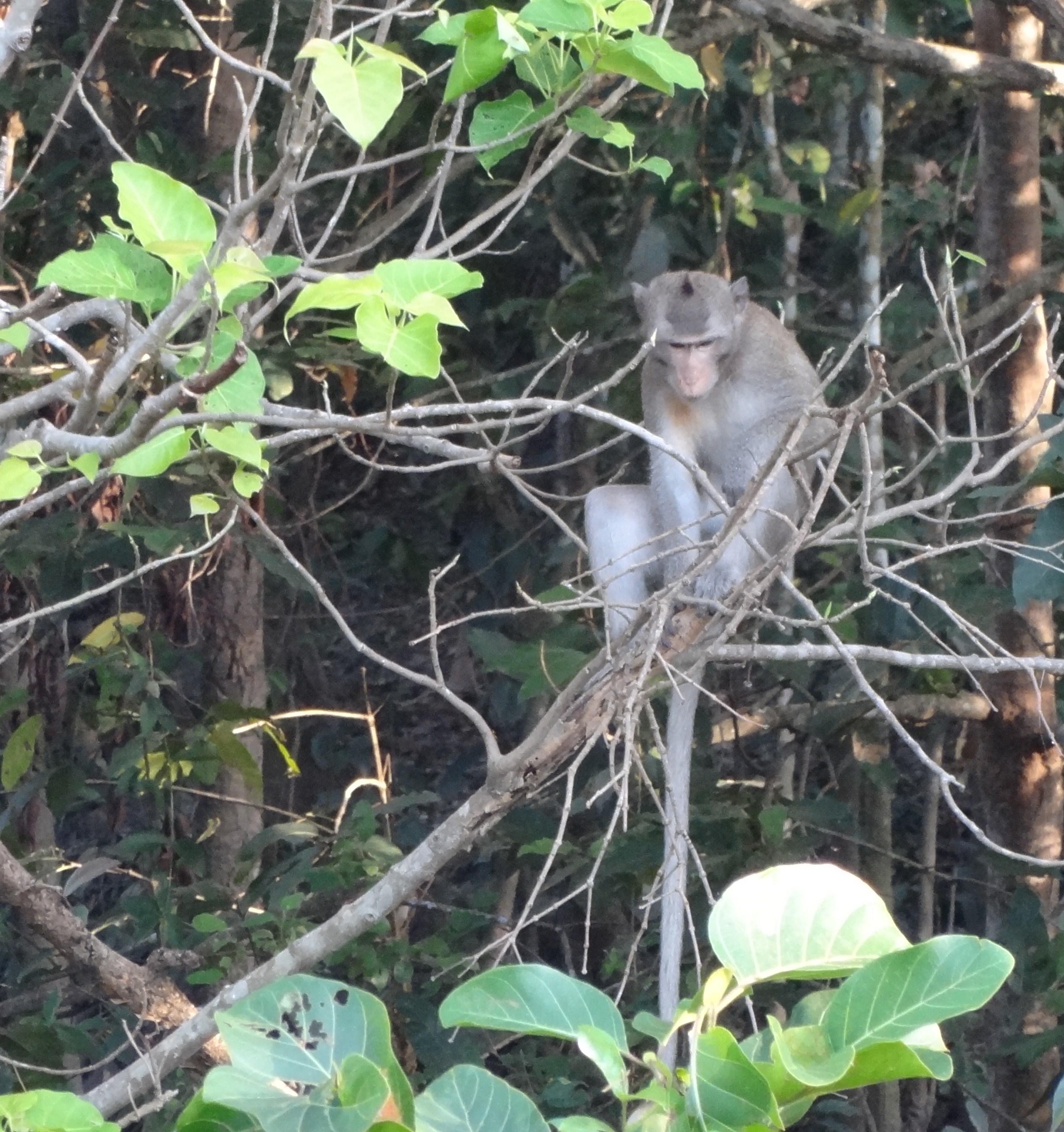
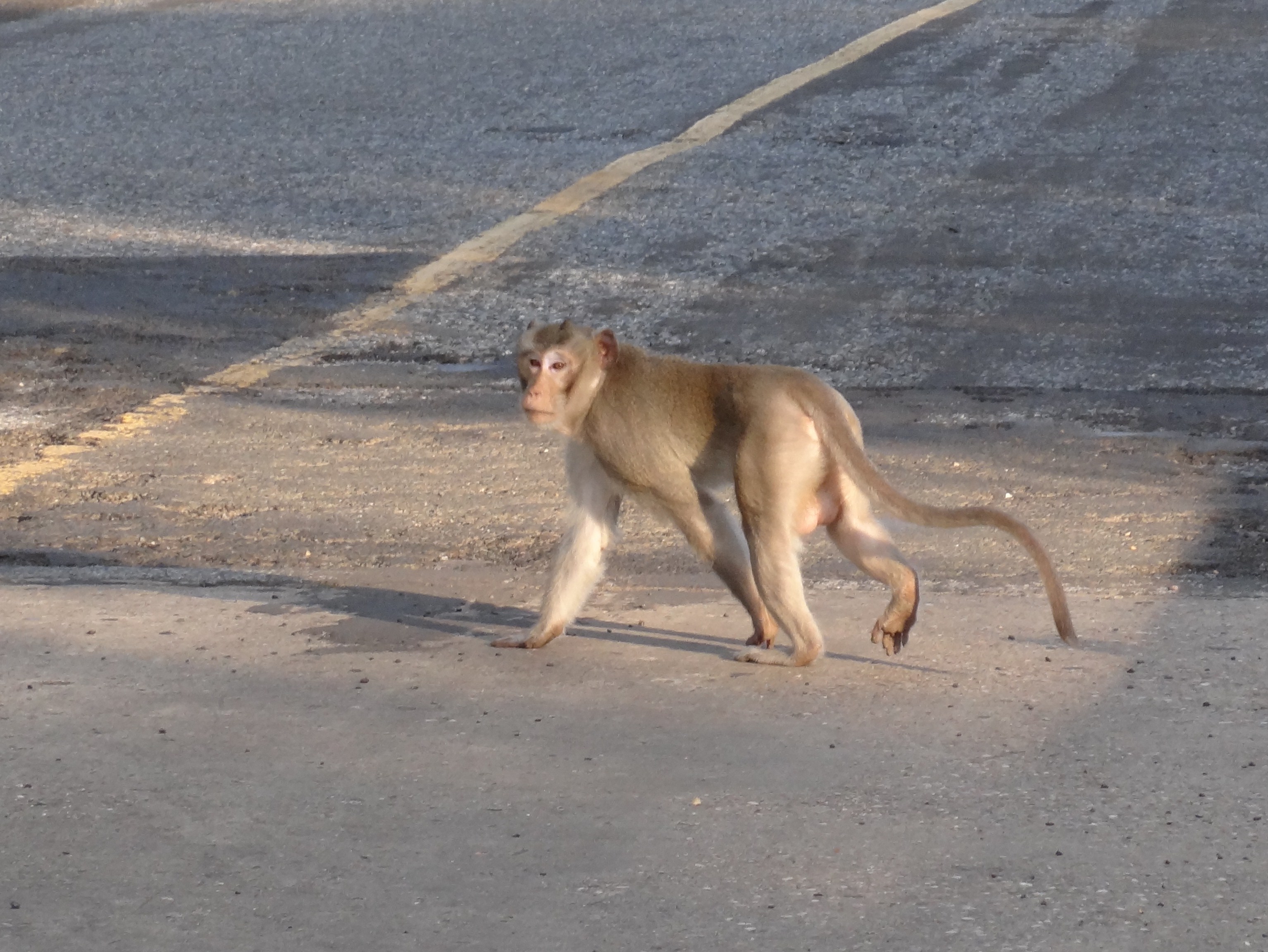
The first monkey I ever saw at Don Jik was an older male, about a year ago, and I caught him on camera leaving the bridge along the road towards Don Chao Poo.

He was not particularly happy, I thought. The picture below is of very poor quality but agin if you enlarge it, you will see that he is carrying an injury similar to the ones we have seen on the male and female above.

I assumed at the time that he was an intruder from Don Chao Poo.  Certainly, at Don Chao Poo there are older male individuals who seem to spend their time outside any group. Presumably, they are former alpha males who have been supplanted by younger, stronger, more virile rivals. Now I am not so sure. It is also possible that he was being expelled from the colony at Don Jik. Of course, it may well not be the same individual, and he may have been expelled or outcast from either colony (or even both), and attempting to make his way into a new one or to return to his original one.

What happens to these outcast males would seem to be an interesting subject for further research.

Posted in Amnat Charoen Province, Long-tailed Macaques, Macaques, monkey forest, Monkeys, Research | Tagged , , , , , , | 1 Comment

Bringing monkeys back from the edge

I am not qualified to review this book — it is written by and intended for people with a much more academic interest in long-tailed macaques than me. What I can say, though, is that it could not have been published at a more opportune time as far as the Phana Macaque Project goes, since it deals with all the aspects of living alongside these monkeys which are of interest and concern to us in Phana.  It also points to problems we have not yet come up against; and most important of all, it has recommendations for solving some of the problems that we have already encountered or seen the possibility of emerging in the future.

Here are some  quotes which seem particularly relevant to us in Phana. They come from the Thai primatologist who is advising the Phana Macaque Project:

‘In Thailand, there are pros and cons to having a troop of long-tailed macaques living close to humans. Many people benefit from the monkeys, such as banana vendors, hotel owners and shop keepers, but there are also people who live near monkey populations who do not gain any economic benefits but receive damage. Up to now, there are no concrete management plans nor primatologist participation to overcome the problem of local overcrowding and conflict with humans. The local overcrowding of long-tailed macaques is a delicate matter, and to solve the problem we need mutual understanding among people…

…Management and conservation plans will require cooperation from various groups, including primatologists, veterinarians, local residents, conservationists, governmental agencies, and NGOs. Educational programs are needed to raise awareness in the public, government, and conservation sectors. Education will need to focus on population management and controlling human interaction with long-tailed macaques.’ (Suchinda Malaivijitinond et al., Human impact on long-tailed macaques in Thailand, in Monkeys on the Edge, Part II, The human-macaque interface, Cambridge University Press 2011.)

I will include further quotes from the book in future posts.

Posted in Long-tailed Macaques, Macaca Fascicularis, monkey forest, Monkeys | Tagged , , | Leave a comment

Monkeys on the Edge

MONKEYS ON THE EDGE: ECOLOGY AND MANAGEMENT OF LONG-TAILED MACAQUES AND THEIR INTERFACE WITH HUMANS

Gumert, Michael D.; Fuentes, Agustin; Jones-Engel, Lisa, eds.
Cambridge University Press, 2011.

MONKEYS ON THE EDGE: ECOLOGY AND MANAGEMENT OF LONG-TAILED MACAQUES AND THEIR INTERFACE WITH HUMANS / ed. by Michael D. Gumert, Agustin Fuentes and Lisa Jones-Engel
Cambridge University Press, 2011

ABOUT THE BOOK

Long-tailed macaques (Macaca fascicularis) have a wide geographical distribution and extensively overlap with human societies across southeast Asia, regularly utilizing the edges of secondary forest and inhabiting numerous anthropogenic environments, including temple grounds, cities and farmlands. Yet despite their apparent ubiquity across the region, there are striking gaps in our understanding of long-tailed macaque population ecology. This timely volume, a key resource for primatologists, anthropologists and conservationists, underlines the urgent need for comprehensive population studies on common macaques. Providing the first detailed look at research on this underexplored species, it unveils what is currently known about the population of M. fascicularis, explores the contexts and consequences of human-macaque sympatry and discusses the innovative programs being initiated to resolve human-macaque conflict across Asia. Spread throughout the book are boxed case studies that supplement the chapters and give a valuable insight into specific field studies on wild M. fascicularis populations.

CONTENTS

Foreword David Quammen
Preface
Acknowledgements

Part I. The Status and Distribution of Long-Tailed Macaques:

1. The common monkey of southeast Asia: long-tailed macaque populations, ethnophoresy, and their occurrence in human environments / Michael D. Gumert
Box 1.1. The long-tailed macaques of Karimunjawa (Macaca fascicularis karimondjiwae): a small and isolated subspecies threatened by human-macaque conflict / Nur Afendi, Devis Rachmawan and Michael D. Gumert
Box 1.2. Trade in long-tailed macaques (Macaca fascicularis) / Kaitlyn-Elizabeth Foley and Chris R. Shepherd

2. Distribution and current status of long-tailed macaques (Macaca fascicularis aurea) in Myanmar / Aye Mi San and Yuzuru Hamada
Box 2.1. Preliminary survey of the long-tailed macaques (Macaca fascicularis) on Java, Indonesia: distribution and human-primate conflict / Randall C. Kyes, Entang Iskandar and Joko Pamungkas

3. Distribution and present status of long-tailed macaques (Macaca fascicularis) in Laos and their ecological relationship with rhesus macaques (M. mulatta) / Yuzuru Hamada, … [et al.]
Box 3.1. A possible decline in populations of the long-tailed macaque (Macaca fascicularis) in northeastern Cambodia / Benjamin P. Y.-H. Lee

Part II. The Human-Macaque Interface:
4. Campus monkeys of University Kebangsaan Malaysia: nuisance problems and students’ perceptions / Badrul Munir Md-Zain, Mohamed Reza Tarmizi and Matura Mohd Zaki

5. Human impact on long-tailed macaques in Thailand / Suchinda Malaivijitnond, Yolanda Vazquez and Yuzuru Hamada

6. Macaque behavior at the human-monkey interface: the activity and demography of semi-free ranging Macaca fascicularis at Padangtegal, Bali, Indonesia / Agustín Fuentes, … [et al.]
Box 6.1. Recent demographic and behavioral data of Macaca fascicularis at Padangtegal, Bali, Indonesia / F. Brotcorne, … [et al.]

7. The role of M. fascicularis in infectious agent transmission / Gregory Engel and Lisa Jones-Engel

Part III. Ethnophoresy of Long-Tailed Macaques:

8. Macaca fascicularis in Mauritius: implications for macaque-human interactions and for future research on long-tailed macaques / Robert Sussman, Christopher A. Shaffer and Lisa Guidi

9. The support of conservation projects through the biomedical usage of long-tailed macaques in Mauritius / Nada Padayatchy

10. Ethnophoresy: the exotic macaques on Ngeaur Island, Republic of Palau / Bruce P. Wheatley

Part IV. Comparisons with Rhesus Macaques:

11. India’s rhesus populations: protectionism vs. conservation management / Charles Southwick and M. Farooq Siddiqi
Box 11.1. Managing human-macaque conflict in Himachal, India / Sandeep Rattan

Part V. Understanding and Managing the Human-Macaque Interface:

12. Developing sustainable human-macaque communities / Lisa Jones-Engel, … [et al.]
Box 12.1. Management of nuisance macaques in Hong Kong / Chung-Tong Shek
Box 12.2. Lessons and challenges in the management of long-tailed macaques in urban Singapore / Benjamin P. Y.-H. Lee and Sharon Chan

13. Future directions for research and conservation of long-tailed macaque populations Michael D. Gumert, … [et al.]

Index

ABOUT THE AUTHORS

MICHAEL GUMERT is and Assistant Professor in the Division of Psychology at Nanyang Technological University, Singapore, where he leads a field program investigating the behavioral biology and ecology of Macaca fascicularis in Indonesia, Singapore, and Thailand. Recent research has focused on practical issues facing long-tailed macaque populations, and he has organized international experts in a cooperative group to better understand the conservation and management needs of long-tailed macaques.

AGUSTIN FUENTES is Professor of Anthropology and Director of the Institute for Scholarship in the Liberal Arts at the University of Notre Dame. His current research projects include assessing behavior, ecology, and pathogen transmission in human-monkey interactions in Southeast Asia and Gibraltar and examining the roles of cooperation, social negotiation, and niche construction in primate and human evolution.

LISA JONES-ENGEL is a Senior Research Scientist at the Washington National Primate Research Center, University of Washington. Her current research focuses on cross-species infectious agent transmission and she coordinates several multidisciplinary research projects in Asia, which focus on the role synanthropic macaques play in disease transmission.

ORDERING INFORMATION
ISBN 9780521764339 $99.00
Cambridge University Press
100 Brook Hill Dr.
West Nyack, NY 10994-2133
Tel: 845-353-7500
Fax: 845-353-4141

Link to order online:
http://www.cambridge.org/us/catalogue/catalogue.asp?isbn=9780521764339

Posted in Long-tailed Macaques, Macaca Fascicularis, Macaques, Monkeys | Tagged , , , , | Leave a comment

Report on Monkey Survey at Phana

Report on Monkey Survey at Phana

Research teams from Thailand: Prof. Dr. Suchinda Malaivijitnond

Primate Research Unit, Department of Biology, Faculty of Science, Chulalongkorn University, Bangkok, Thailand

Tel/Fax: 02-2185275

E-mail: suchinda.m@chula.ac.th

Mr. Sarawoot Gomuttapong (Graduate student)

Mr. Sarun Asawanuchit (Graduate student)

Department of Biology, Faculty of Science, Chulalongkorn University, Bangkok, Thailand

Research teams from Japan: Prof. Dr. Yuzuru Hamada

Evolutionary Morphology Section, Primate Research Institute, Kyoto University, Inuyama, Japan

Tel: +81-568-63-0521, Fax: (+81)-568-61-5775

E-mail: hamada@pri.kyoto-u.ac.jp

Mr. Yahiro Kazuya (Undergraduate student)

Faculty of Liberal Arts, Kyoto University, Japan

Mr. Fujimoto Shunpei (Undergraduate student)

Faculty of Agriculture, Kyoto University, Japan

Mr. Mizutani Hiroki (Undergraduate student)

Faculty of Economy,Kyoto University,Japan

Ms. Okazaki Sachiko (Undergraduate student)

Laboratory of Veterinary Physiology, Department of Veterinary

Medicine, Faculty of Agriculture, Tokyo University of

Agriculture and Technology, Fuchu, Tokyo, Japan

Research Duration: September 8-9, 2011

The brief survey of monkeys at Phana was done by a research team, within a later half day of September 8 and a few hours in the morning of September 9, 2011, as a part of the International Symposium “Biodiversity and ecology of wildlife in Thailand”. This symposium was hosted by the Department of Biology, Faculty of Science, Chulalongkorn University, Thailand in collaboration with the Primate Research Institute of Kyoto University, Japan.

Monkeys at Phana District,  Amnat Charoen Province are Macaca fascicularis with common names of crab-eating macaques, cynomolgus macaques or long-tailed macaques. In Thailand, they are locally called by various names, such as “Ling Samae (“Ling” = monkey, Samae = name of crab at the mangrove forest)”, Ling Hang Yaow (Hang = tail, Yaow = long)” or “Ling Thep Pranom (which is based on the crest hair being like “Wai or Pranom”)”.

Generally, their distribution is from southern Bangladesh, eastward to Myanmar, Thailand, Laos and Vietnam, and southward to Malaysia, Singapore, Philippines, and Indonesia, including the Nicobar islands in India. In Thailand, their distribution is from the lower northern (latitude 16.30 °N, at Pichit and Nakhon Sawan Province) to the southernmost Thailand (latitude 6.15 °N, at Yala and Satun Province).

In each sex, they can be categorized into 4 age-classes as follows:

Adult female: fully mature female with huge body size, but smaller than adult male, big, red and long nipples, the sex skin is reddening or swelling during ovulation time.

Sub-adult female: female with intermediate body size, small, not very red and short nipples, the sex skin is reddening or swelling during ovulation time. At Phana, some sub-adult female showed the scotum-like swelling (Malaivijitnond et al., 2007).

Adult male: fully mature male monkeys with huge body size, fully grown canines and the testes fully descended into the scrotal sac.

Sub-adult male: male monkeys with intermediate body size, partially grown canines and the testes partially descended into the scrotal sac.

Juvenile: in male monkeys, small body size and the testes are in the abdominal cavity, not descended into the scrotum. In females, small body size and they do not have sex skin swelling and reddening. Both sexes usually stay together as a group.

Infant: baby monkey attaching or hanging with mother (age <1 year), small body size, many wrinkles and black hair on face, usually staying within a distance of 1 m from mother.

Don Chao Poo (Sacred forest) in Phana District, Amnat Charoen Province (N15O 36’36.4”, E104O 50’ 53.1”) is located in the distribution range of this species. A population of long-tailed macaques inhabiting Phana was first counted in October 2004. There were 3 groups of monkeys with 378 individuals counted, but we estimated that they should have about 600 monkeys (Malaivijitnond et al., 2011). The habitat of Phana monkeys is a patchy forest as we particularly found in many locations in Thailand. During this time of our visit, 3 groups and 464 individuals were counted (but we estimated that they should have more than 600 monkeys, because during the day of our survey it was slightly raining and many monkeys hid in the forest).

The macaque population is living in a good condition. No obese monkeys were found (which is regularly seen in many tourist attraction sites, such as Sarn Pra Karn, Lopburi Province). However, the population composition is biased to younger age classes; infants and juveniles are of  higher frequency and about 60% of adult females are lactating with infants. It means that the fecundity is high and the population high and  is increasing rapidly.

We could see many social activities between monkeys here, such as fighting between female monkeys, grooming (both autogrooming and allogroming), copulating, playing in juveniles, and foraging for foods.

As macaques tended to be found in the visitors’ place or on the road, they appear to depend on provisioning from humans. High calorie, but low quality, foods, such as potato chips, could lead to the population increase. Provisioning to macaques also raises other problems of injured monkeys. Provisioning on the road while humans are in the cars persuades monkeys to the road and has caused a bad habit of begging for food, and many monkeys got injured by traffic accidents. Several macaques are found with wounds remaining on their body, some are severe and some are light. Also, direct contact with monkeys can cause the bidirectional transmission of diseases between humans and monkeys, such as tuberculosis and simian viruses.

Phana monkeys have such a unique behavior of making tight aggregation of individuals, sometimes 20-40 individuals, which we have not seen in other groups of long-tailed macaques in Thailand. It usually occurs in monkeys living in a cold weather, such as in Japanese macaques.

The population is rather isolated from other populations of conspecifics, and thus the genetic heterogeneity is on the course of decreasing. The evidence indicating the low genetic variation (or inbreeding depression) in this group are a supernumerary nipple and light-coloured pelage. Provisioning would have driven the higher ranked lineage to increase in population more than the lower ranked. A monkey with a tumor was also observed.

Human – monkey conflicts are not yet severe, though it threatens to become severe as in Lopburi and Khao Wang Petchaburi in the future. Damage on humans (injury by biting and scratching, or falling down by threatening of monkeys), at houses (stealing food and damage on houses) or cars would occur. On the other hand the counter-measures such as catching and translocation of monkeys by humans would be taken.

Recommendations

Phana macaques and wildlife are the symbol of harmonic co-existence of life of humans and nature. Monkeys and wildlife are treasure of Phana. However, management is indispensable as they are under the influence of human impact. Recommendations for management are written as follows:

1. Control of population: The amount of provisioning should be controlled. Contraceptive protocol, which do not influence on the sex-hormone secretion, should be considered, such as tubule (of vas deferens) ligation in male monkeys. Population structure and lineage structure (kin groups in the troop) should be studied.

2. Provisioning should be made only inside park. Provisioning on or along road should be banned. Construction of bumps on the road to reduce speed of cars and to prevent traffic accident on monkeys.

Provisioning foods should be scattered in many points, then all monkeys can have access to the food, and the higher rank monkeys can’t monopolize food.

3. Human-monkey interactions and control of bidirectional transmission:

To prevent conflict becoming severe, the way of provisioning should be controlled. Direct contact between humans and monkeys should be kept minimal. Instruction to visitors for the way of contact with monkeys, such as not to look at monkey’s eyes, which means threatening monkeys and monkeys will counter attack to that person.

To prevent zoonosis and humanosis, transmission of diseases to and from monkeys, the way of contact, including the way of provisioning and watching monkeys should be instructed.

Drinking water for monkeys without contamination should be installed, because nowadays the monkeys drink dirty (contaminated with pathogens) water.

Keep clean the provisioning site.

Fruit trees should be planted for monkeys to eat.

1. Malaivijitnond S, Hamada Y, Suryobroto B, Takenaka O. 2007. Female long-tailed macaques with scrotum-like structure. American Journal of Primatology. 69 (7):721-735.

2. Malaivijitnond S, Vazquez Y, Hamada Y. 2011. Human impact on long-tailed macaques in Thailand. (In Managing Commensalism in Long-tailed macaques, Lisa Jones-Engel, Michael Gumert, Augustin Fuentes, eds).CambridgeUniversityPress,UK. Pp. 120-160.

Acknowledgements

We would like to thank the Primate Research Institute, Kyoto University, Japan and the Primate Research Unit, Department of Biology, Faculty of Science, Chulalongkorn University for the grant support. We are grateful for the warm welcome and hospitality of Phana people while we visited there, especially to Khun Prachoenlarp Intarachan and Khun Surachet Thongphum for all arrangements, help and support. We also sincerely thank Khun Lawrence Whiting and Ajarn Pensri Whiting for accommodation and arrangement for our team members, and especially for introducing this project to us.

Posted in Uncategorized | Leave a comment

Long-tailed Macaques at Don Jik, Amphur Phana

We try to cycle every morning and our route takes us onto the Phana ring road and over the Huay Phra Lao bridge at Don Jik. A small troop of long-tailed macaques lives here but whether or not we see them depends on the time we cycle past. Yesterday we saw them at 8.10 am and this morning we saw them at 6.45 am. Between these two times we have usually not seen any sign of them. We are starting to record the times when we see them and when we don’t, as well as counting the number we do see. So far the most we have seen together has been 16, and we have seen that number on several occasions. However, a local farmer whose fields they sometimes raid estimates their number to be about 30. I first wrote about this colony in March 2011 and you can read that post here:
http://phanathailife.typepad.com/thai-life-phana/2011/03/a-breakaway-colony-of-long-tailed-macaques-in-phana.html

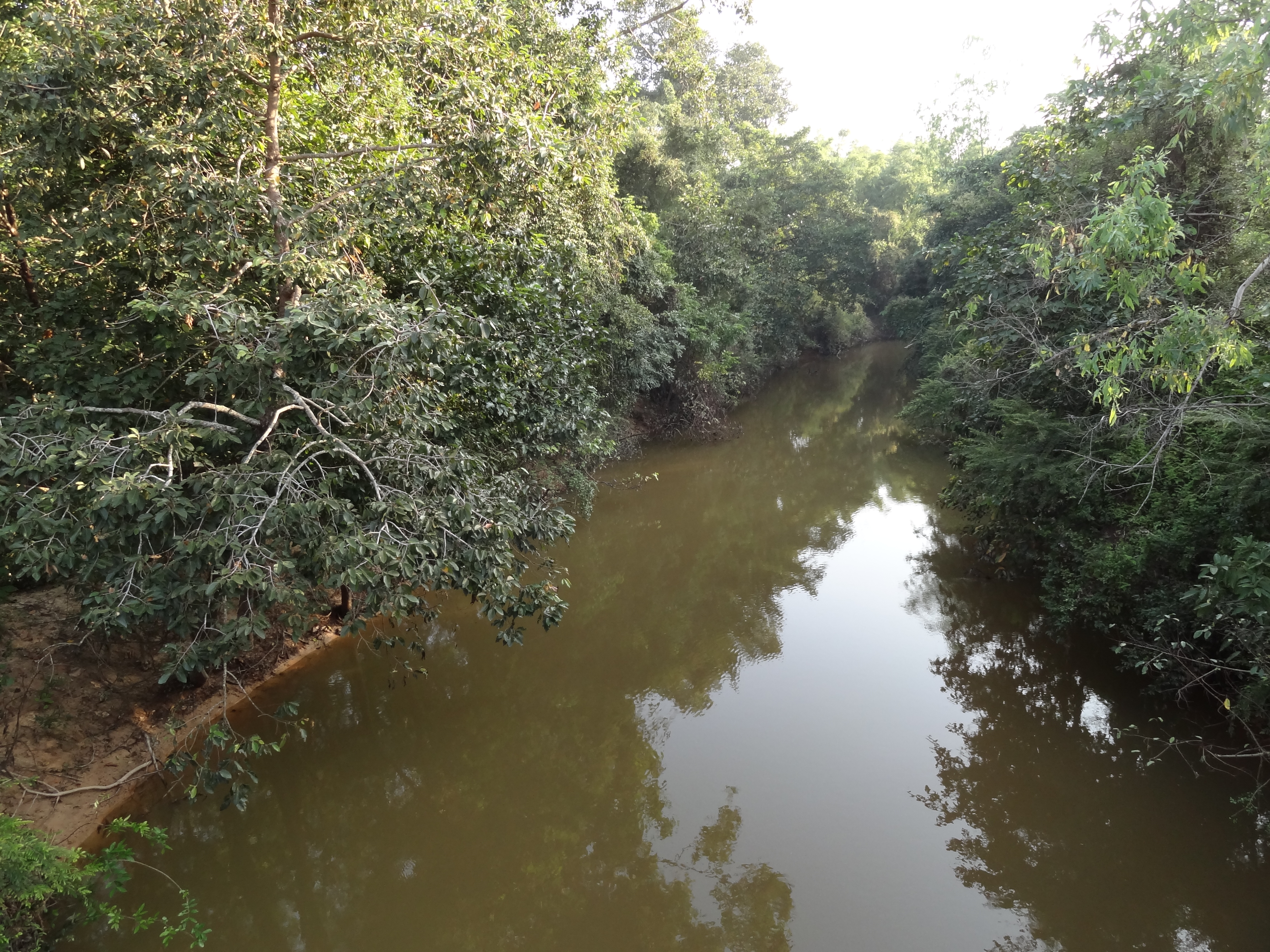
From their point of view, the monkeys have an almost perfect habitat. They live beside the small tree-lined river (Huay Phra Lao) which has some water all year round.

Looking South at Don Jik Bridge

Looking North at Don Jik Bridge

They spend time resting, playing and sleeping (and presumably foraging for food) in the river-side trees:

Natural setting, Don Jik

The monkeys spend some time on both sides of the road and could easily cross from one side to the other by going along either bank of the river below the bridge. But for some reason they prefer to cross the road, which is usually empty but also has some big, fast moving traffic at times — buses and trucks, mostly. The alpha male seems to act as a kind of crossing patrol. Here he is, striding about the road in a very confident manner:

Alpha male at Don Jik

The high-ranking female also acts as a kind of guardian, seeing that her offspring cross the road when she wants them to. I have heard her calling them on two occasions and she waits for a responding call before leaving the bridge. I have not been aware of hearing such calls in Don Chao Poo, but it is something I shall now be on the alert for.

High-rank female at Don Jik

Click on the photo to enlarge it, and you will see that she has a supernumerary nipple below her right normal one. (There may be two supernumary nipples, but I think the one on the right is a shadow only.) When she visited Phana earlier this year (September 8 and 9, 2011) Dr Suchinda Malaivijitinond noticed the same pattern on a female in Don Chao Poo Forest.

This might, of course, suggest that the two colonies are related. They are, after all, only about 2 kms apart as the crow flies (or the monkeys range). Local wisdom says that they were ‘dumped’ here about 5 years ago from a truck which had brought them from Don Chao Poo as part of a failed ‘kidnap’ attempt.

Posted in Amnat Charoen Province, Long-tailed Macaques, Macaca Fascicularis, Macaques, Monkeys | Tagged , , , , , | Leave a comment

What should we do about the monkeys?

What should we do about the monkeys?

In Phana,  we have to continue down the road we have been going for the last thirty years or so. There can be no turning back.

But it is worth considering what it is that we have been doing for the last 30 years.

By feeding the colony that lives in Don Chao Poo, we have:

protected them from farmers and others who might have killed them in order to defend their crops and property;

limited their ‘ranging’  prolonged their lives, resulting in population growth and a diminishing share of their natural habitat and food supply;

made them become lazy and greedy;

made them become familiar with humans, unafraid of them, and sometimes aggressive towards them;

introduced them to  foods which may not be appropriate for them.

In effect, we have domesticated them.

On the other hand, if we had fired catapaults at them and had not fed them, they would have lived a more natural life. They would have remained the ‘wild’ creatures we imagine we want them to be.

But we would have been denied the feel-good factor.

Hopefully,  if Phana succeeds in its current aim to set up some sort of educational centre in or near Don Chao Poo, we will learn how to treat our monkeys better and begin to see them for themselves and not merely as a means of making ourselves feel good.

Posted in Long-tailed Macaques, Macaca Fascicularis, Macaques, monkey forest, Monkeys | Tagged , , , , , | Leave a comment

Birth of the Macaque Project (2)

Phana is sometimes known as ‘Monkey Town’. I am not sure that the
people of Phana really like that, but I notice that there is a large, framed
collage of photos labelled MONKEY TOWN just outside the Mayor’s office at Tetsaban Phana. Certainly the monkeys that live in our local forest are a draw for a small number of tourists and visitors from the nearby towns and villages.

What is less certain is whether or not Phana gains anything from this tourism or whether the monkeys gain any real benefit from it. We gain litter, yes,  but that may be all other than a certain notoriety. But I wonder whether Phana needs to gain anything, at least in the sense of profiting from the presence of the monkeys.

The monkeys do make us feel good. Phana lives quite comfortably with them (give or take a few complaints from farmers whose land adjoins the forest). It has generally been regarded as auspicious that the monkeys live in Don Chao Poo, home to the town’s guardian spirit, and to four Buddha images.  People feel privileged to be host to the monkeys. The people who come from outside to feed them evidently feel good about doing so, even if some of the girls scream when large monkeys make a grab for food they are holding.

Why do we love the monkeys so?

They make us feel at one with nature, I think. We are consorting with ‘the wild things’ when we go into the forest to feed them. Feeding them makes us feel kind and generous.

Feeding these monkeys makes us forget that we have exterminated most of the wild things around here.

At the same time, we see these long-tailed macaques as very human-like: the babies are cute, the mothers take good care of them; the young males respect the older males, the older males look wise and are very macho.

This may be the world as we would like it to be.

But it is time for Phana to re-think its relationship with the monkeys here. The Governor of Amnat Charoen Province has suggested (with a little prodding, perhaps) that some sort of ‘Centre’ should be established in connection with them. Selling souvenirs may have been the extent of his thinking on the subject. Several people have put forward the idea of an educational facility, a Study Centre, and contact has been made with Thai academics who are interested in the study of primates and their place in the ecosystem (see the page ‘Macaque Project‘). First, though, we must decide exactly what sort of relationship we want to have with the monkeys, and what sort of habitat we are willing to allow them.

COMMENTS and SUGGESTIONS would be very much appreciated.

Posted in Long-tailed Macaques, Macaca Fascicularis, Macaques, monkey forest, Monkeys, Tetsaban Phana | Tagged , , , , , , , | Leave a comment

Birth of the Macaque Project (1)

The Phana Macaque Project came about largely because of a few blogs I wrote earlier this year on Life in Phana (www.phanathailife.typepad.com). I had been in and out of the monkey forest, Don Chao Poo, on a daily basis and had got to know many of the long-tailed macaques well. Not just got to know them, but I had also begun to be concerned about their welfare.

This blog is concerned solely with the monkey forest in Phana, so it seems sensible to include those three posts on this site. The first was about feeding the monkeys and the pleasure it gives me to be with them.

Feeding the monkeys in Don Chao Poo forest, Phana, can be a very rewarding experience. But it can sometimes be an alarming experience. Sometimes the monkeys are calm and patient; sometimes they are greedy and aggressive. Sometimes we are calm, too, and sometimes we panic too easily and monkeys and humans become frightened.

One of the things that causes lots of people to panic is when a monkey starts to pull at your clothing, or to climb up it. But as you see here, there is no need to panic.

But at times when they are particularly hungry perhaps, there will be a scramble to get food from visitors. But this does not always happen. If you have plenty of food to give, and especially if you can scatter it on the ground, it is much less likely to cause aggressive behaviour amongst the monkeys. And sudden, mock-aggressive movements by you, such as swinging the bag towards the invasive monkey, will make them keep their distance.

Human panic is one of the reasons that plastic bags get strewn about; someone less confident than this monk might allow a monkey to snatch the bag and run off into the forest with it. More often, though, it is humans who dispose of the bags they bring by throwing them down when empty. As I have mentioned in a previous post, the few bins there are in the forest are useless because the monkeys pull out all the litter and scatter it about.

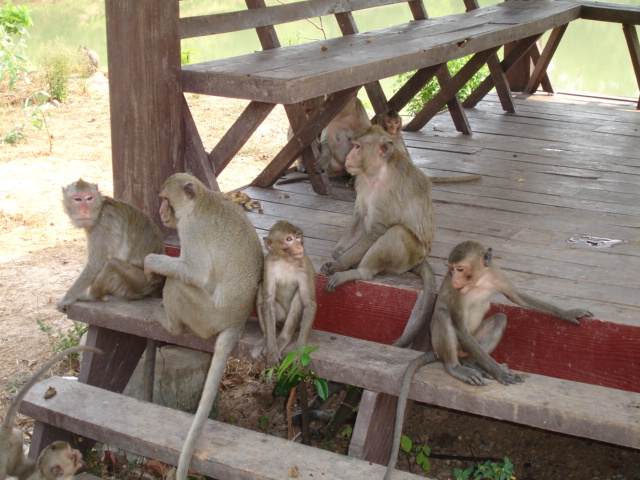
But you don’t have to feed the monkeys to enjoy being with them. Early in the morning, round about mid-day and in the middle of the afternoon seem to be times when the monkeys are relaxed, not particularly searching for food, and you can walk and stand and even sit among them and enjoy a peaceful time with them. You can watch them at different times playing, grooming, mating, or just sitting quietly.

Here are some pictures I took on a Sunday afternoon at a sala next to the pond in the forest.

The monkeys were happy to share the place with me, but there was no doubt in their mind that the tetsaban had provided the place primarily for their leisure.

Posted in Long-tailed Macaques, Macaca Fascicularis, Macaques, Monkeys, Tetsaban Phana | Tagged , , , , , , , | Leave a comment

The Monkey Forest: a community space

The monkey forest (Don Chao Poo) is frequently used by the community of Phana for ceremonial and celebratory occasions. The Phana Municipality (Tetsaban Phana) is responsible for the forest and it is the tetsaban which organizes events there.

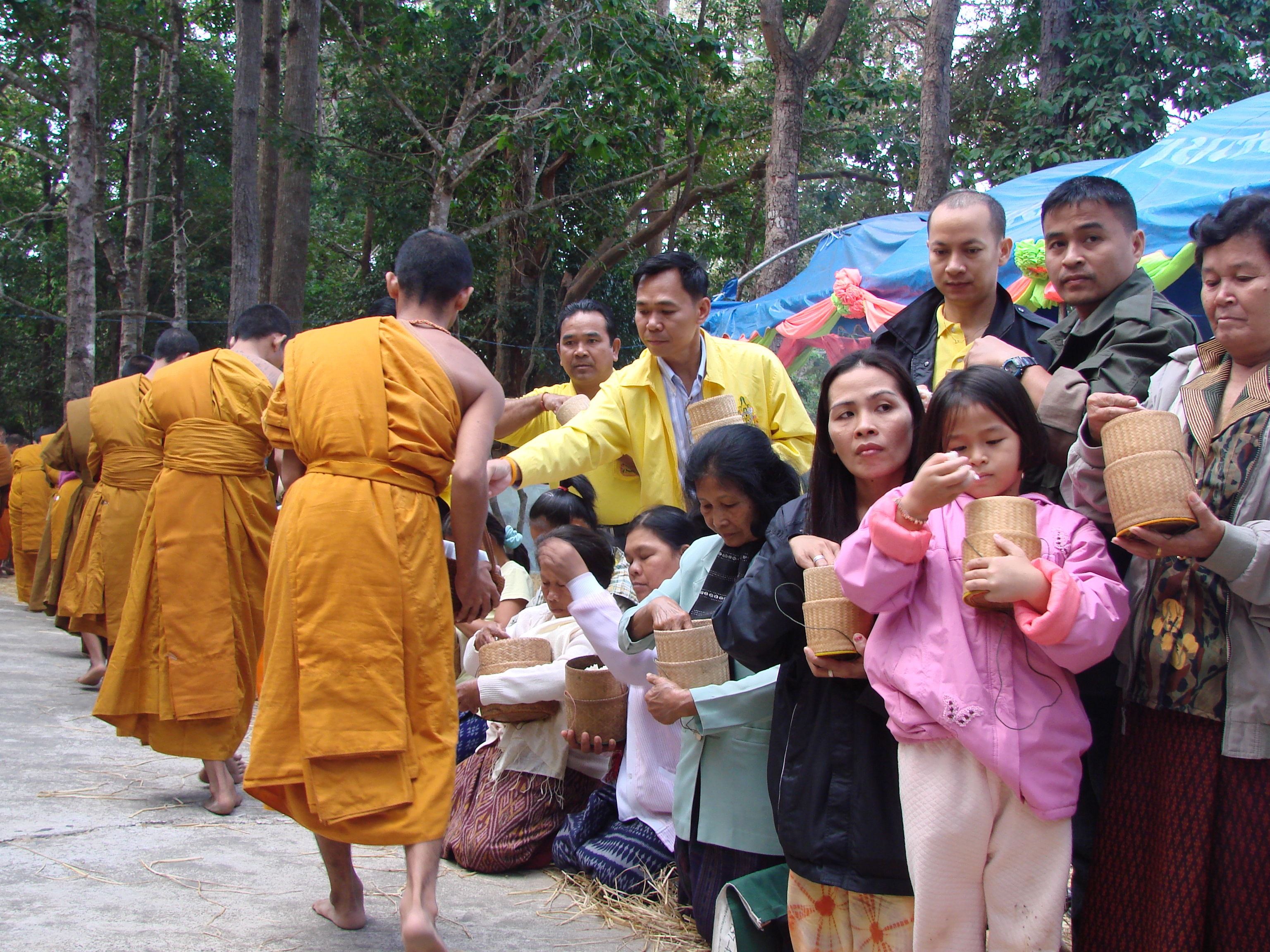
Sometimes the tetsaban is a facilitator, as it is for the annual retreat by monks who spend ten days in December meditating and teaching. The tetsaban prepares the forest for them and organizes a rota to ensure that the food offerings are made each day.

Alms round, Don Chao Poo

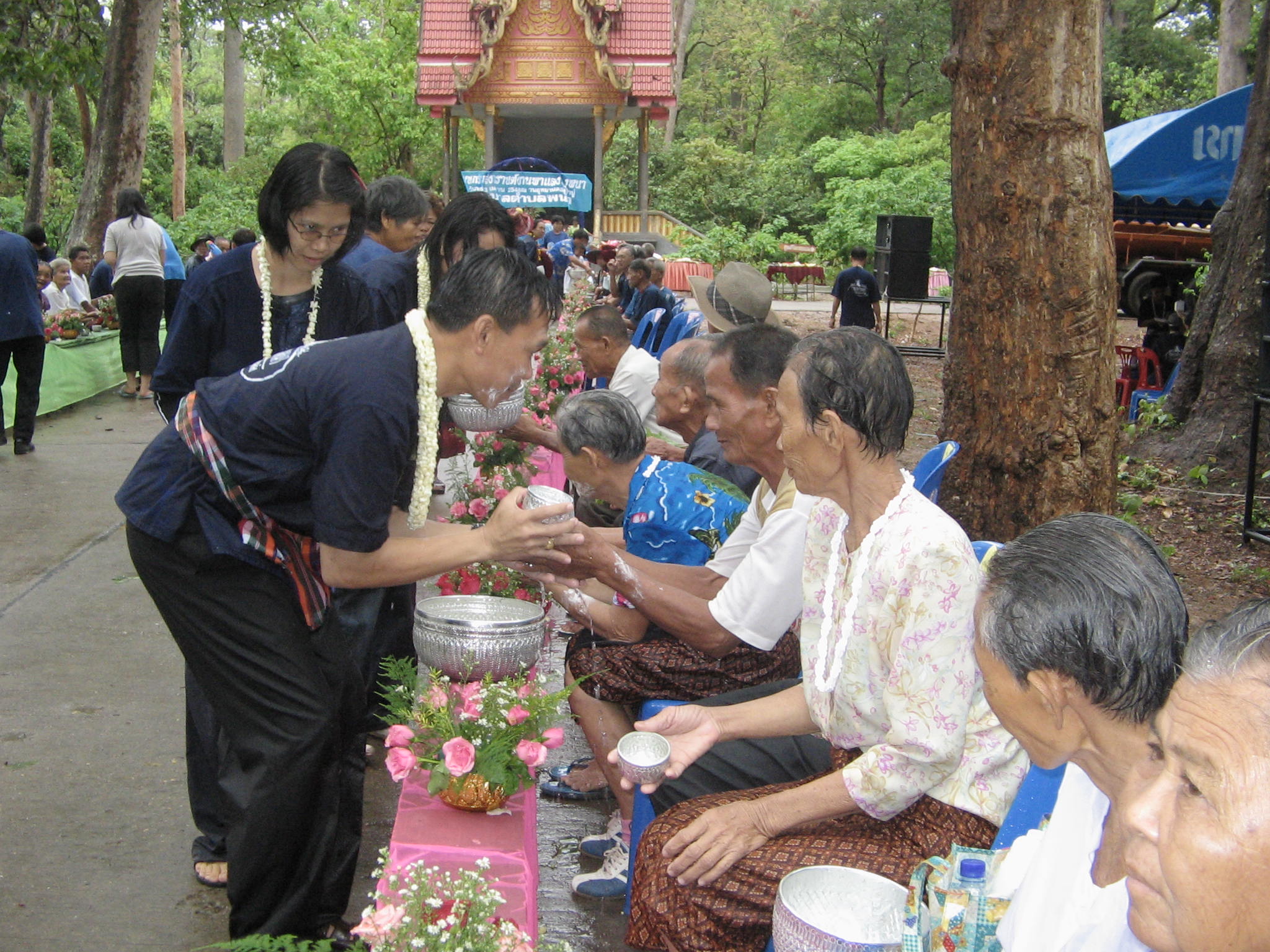
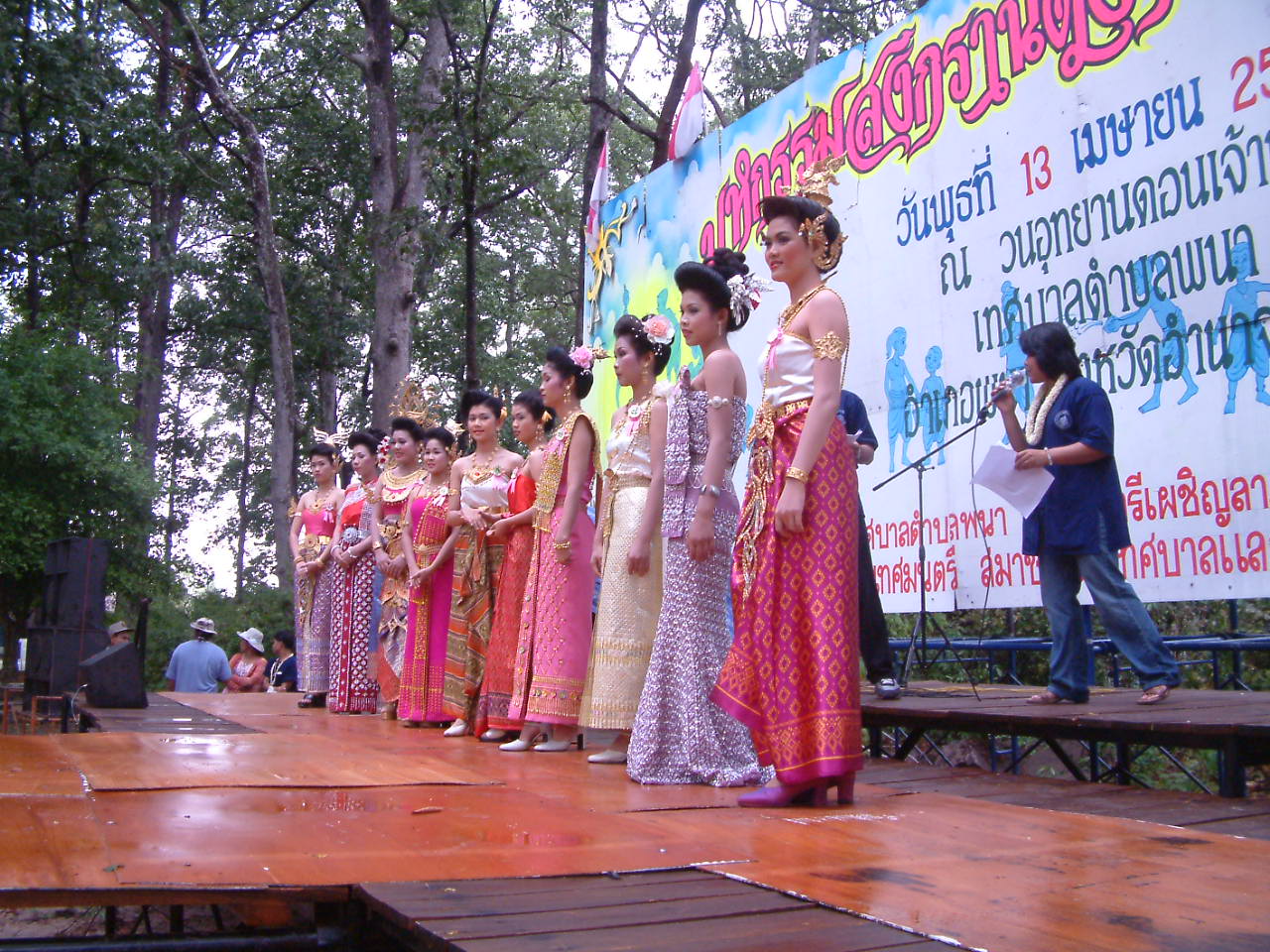
On other occasions such as the celebration of the Songkran festival in April, the tetsaban is more fully involved.

Songkran in Don Chao Poo

Songkran beauties

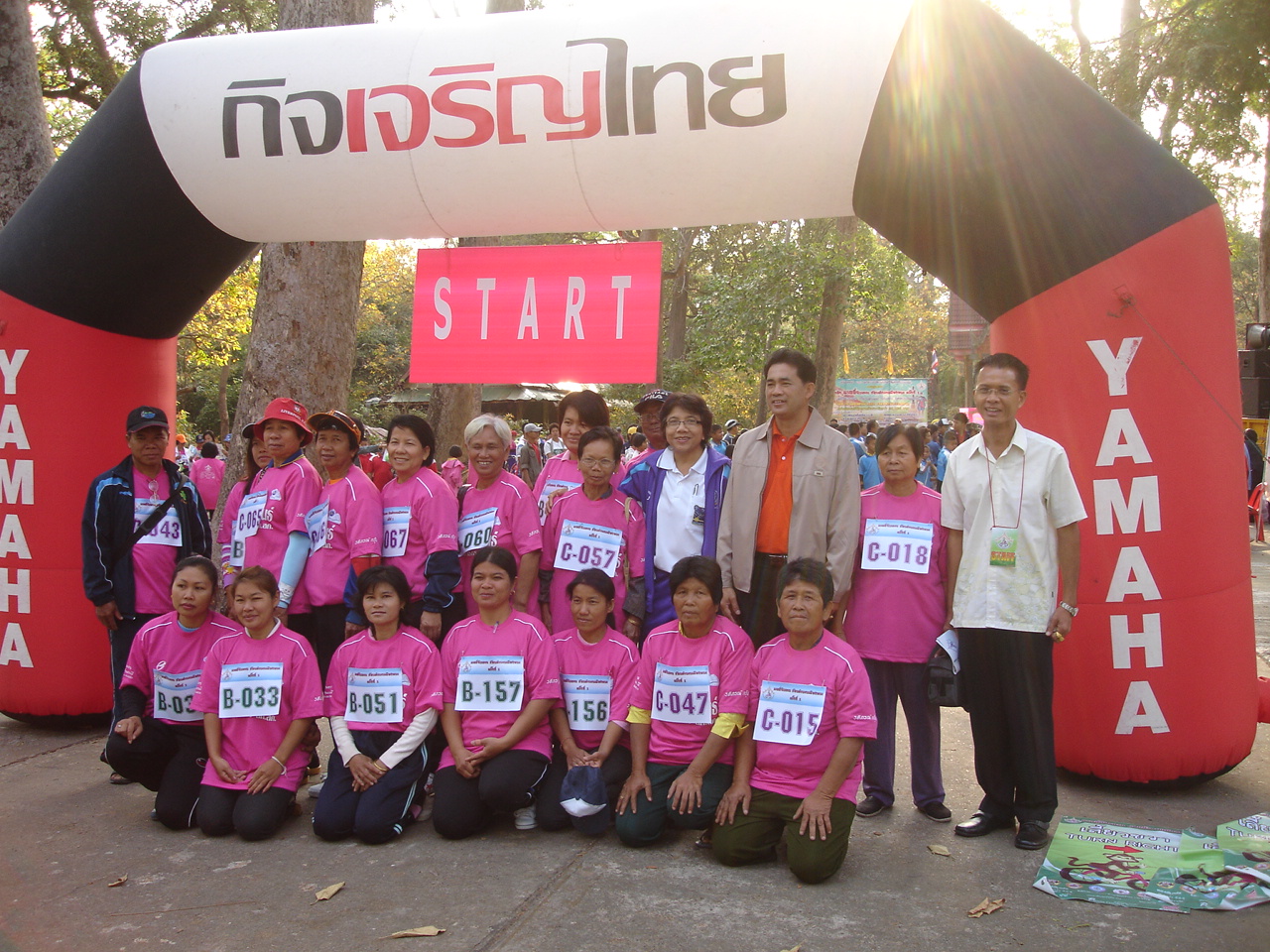
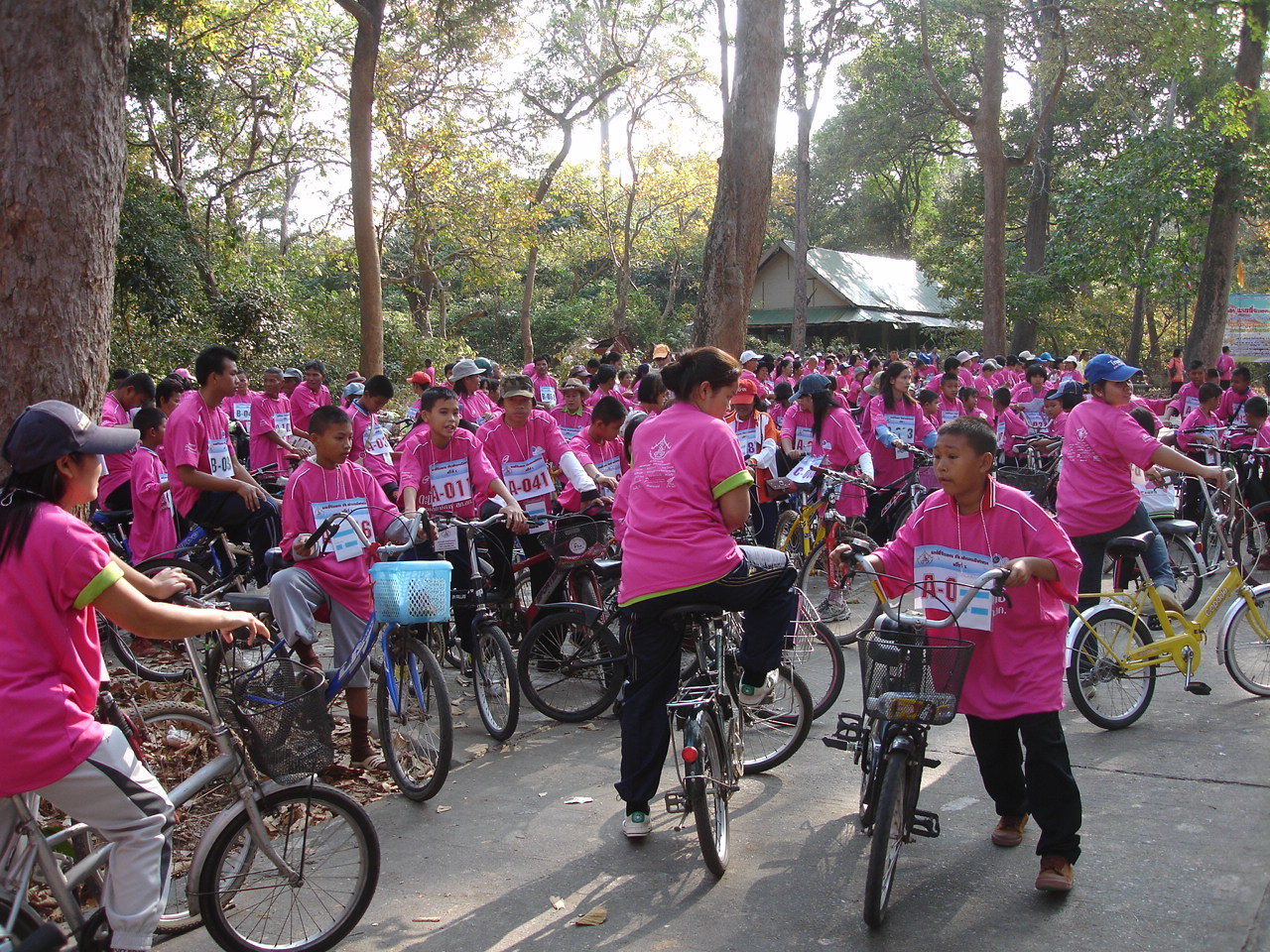
An event that was initiated in 2011 was the bicycle rally on the first day of the Wat Phra Lao festival in February. It is expected to become an annual event. The opening ceremony and gathering of cyclists took place in Don Chao Poo.

Bicycle Rally in Don Chao Poo

Cyclists rally in the Monkey Forest

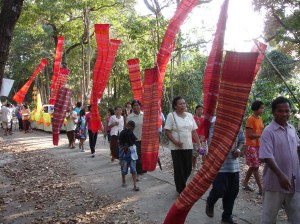
The celebration of Boun Pravet begins in Don Chao Poo before the procession moves off to the wat holding the festival:

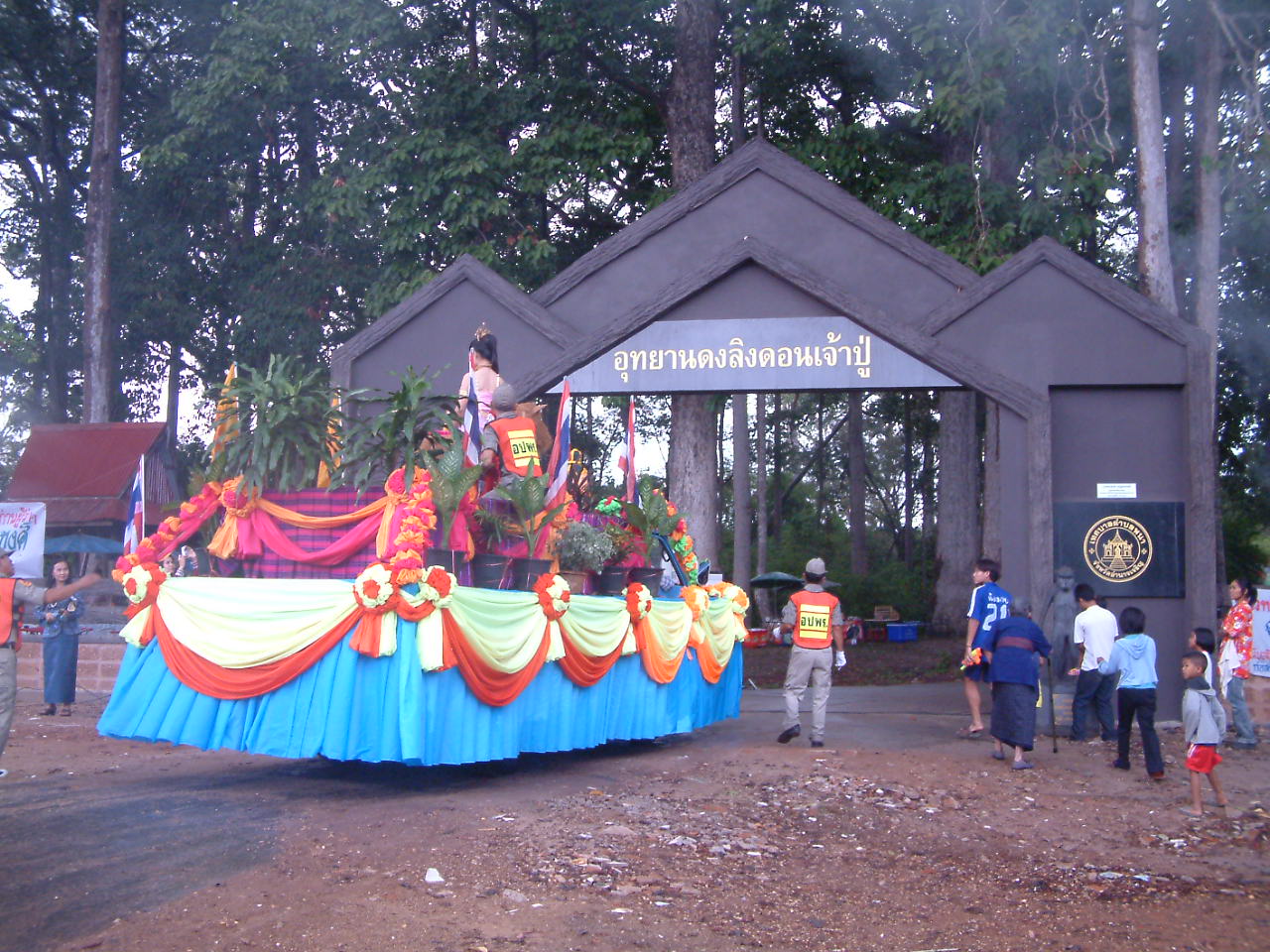
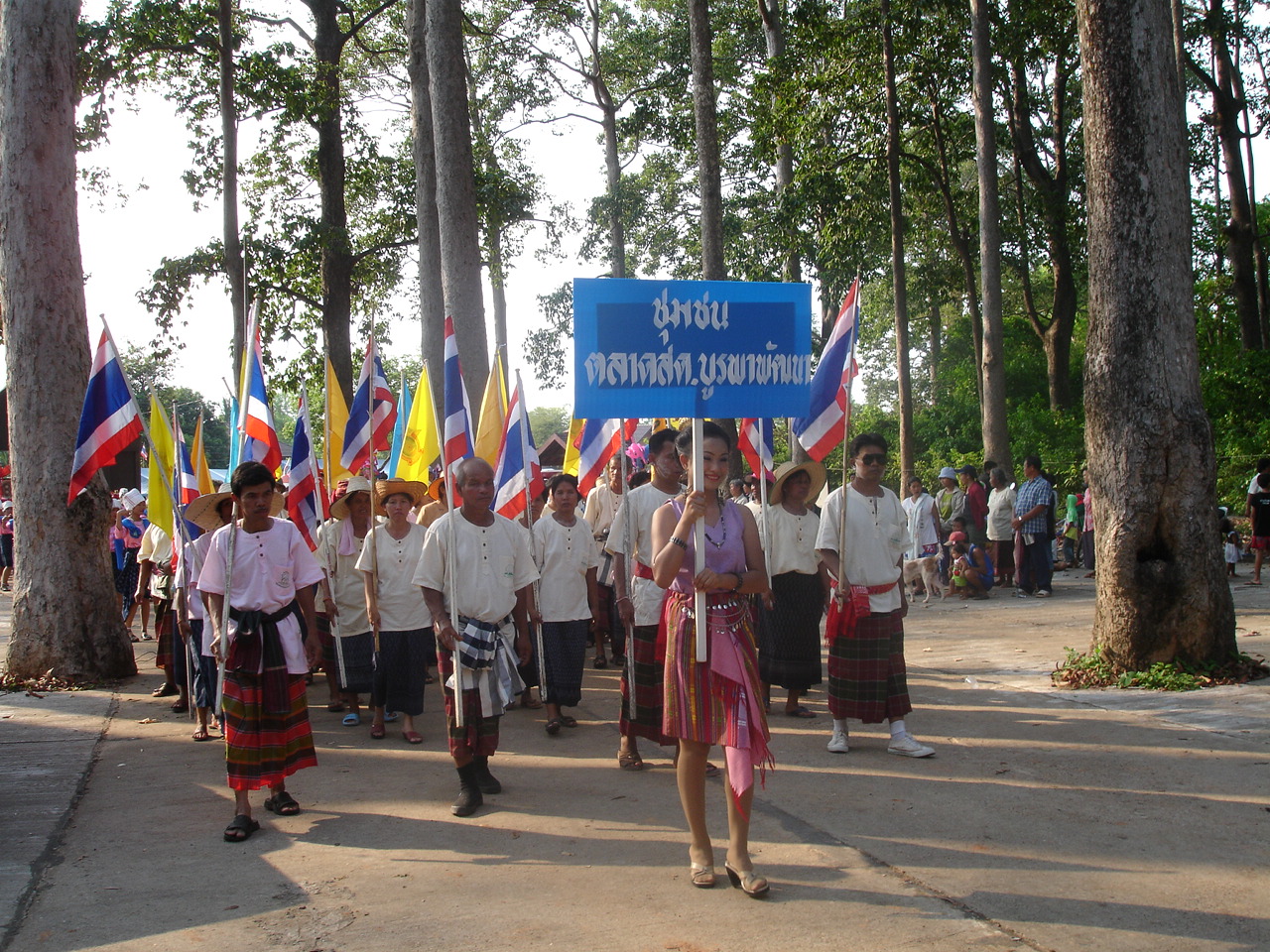
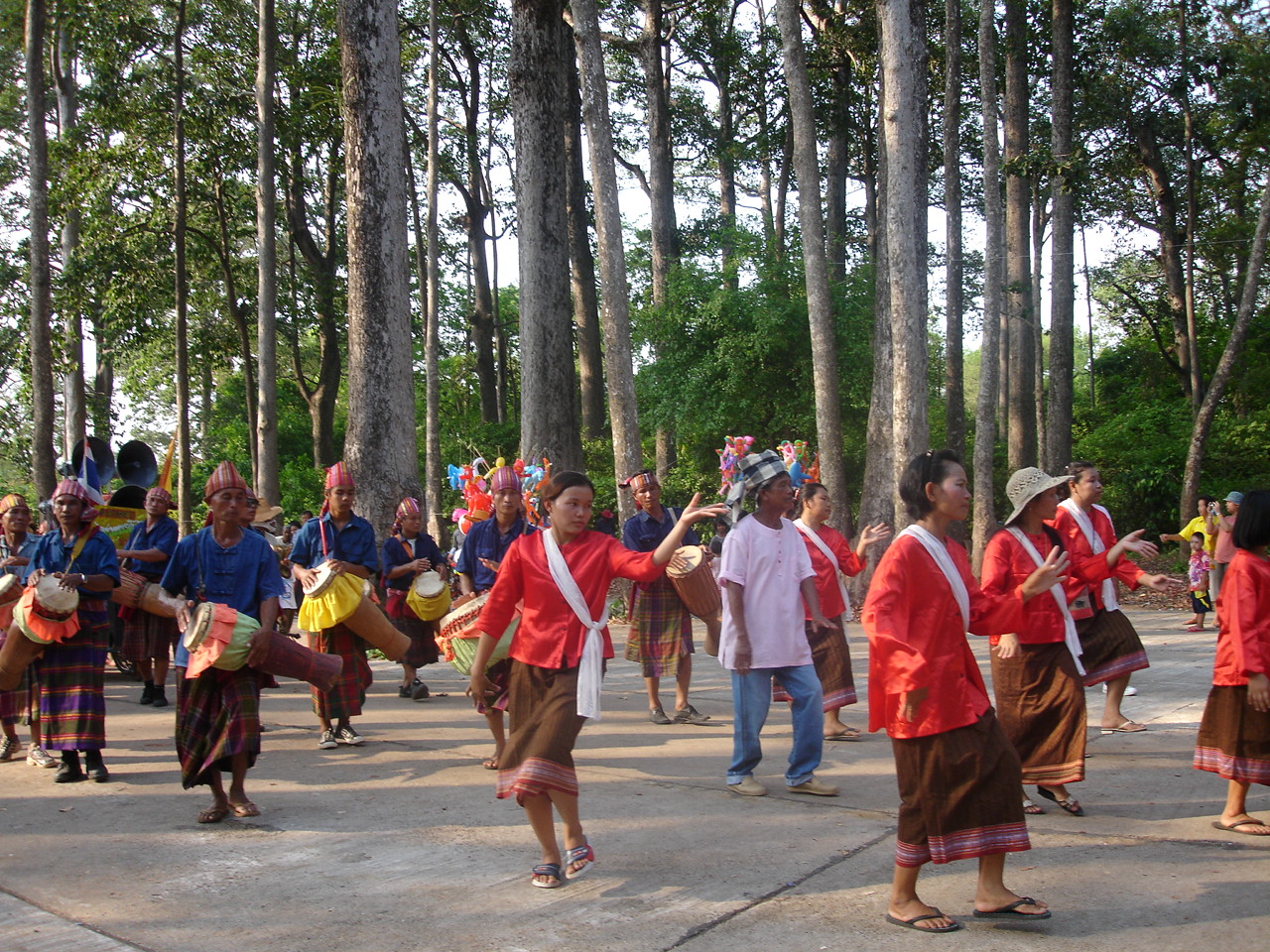
Some parades and processions end at the monkey forest:

Driving into Don Chao Poo

Marching into Don Chao Poo

Dancing into Don Chao Poo

Chao Poo has to be propitiated before using his forest:

Shrine of Chao Poo

And since it is also the monkey forest, the monkeys have to be pleased too:

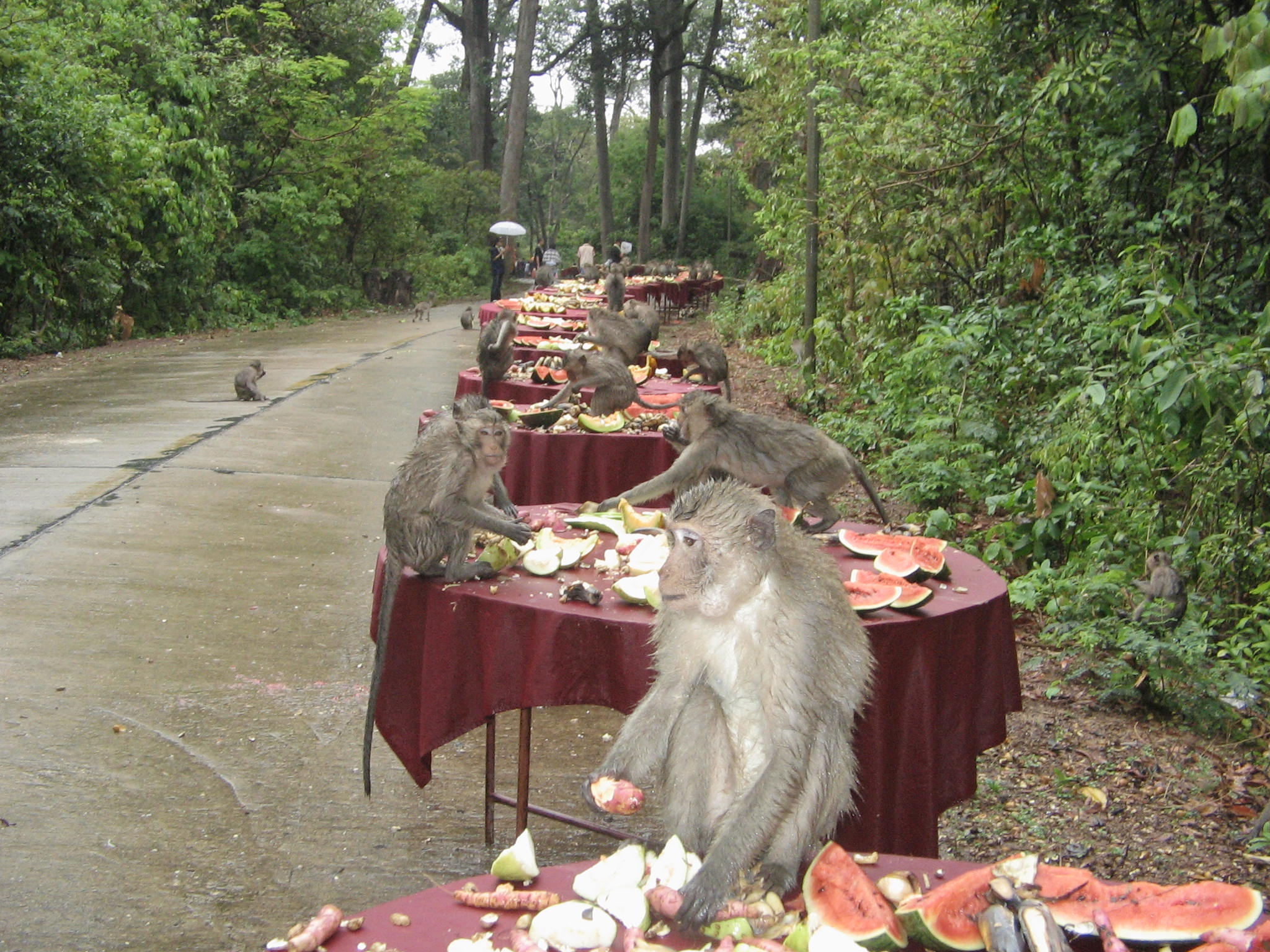
Monkey feast, Don Chao Poo

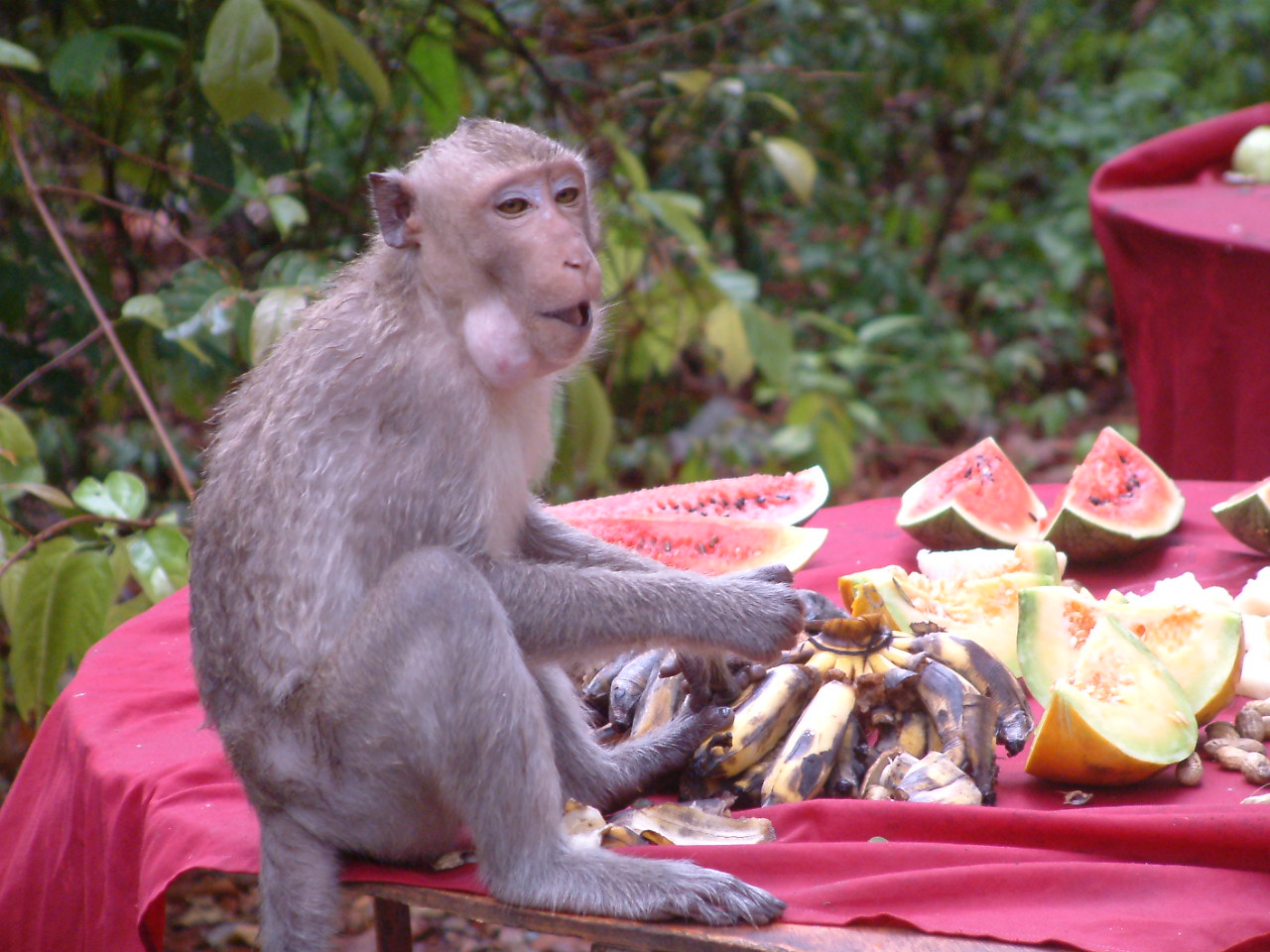
This one certainly looks well-pleased:

Monkey feasting in Don Chao Poo

All these photos can be enlarged by clicking on them. You can see them (and lots more) as a slideshow on the page ‘Community Use’.

Posted in Amnat Charoen Province, Ceremonies and Celebrations, Long-tailed Macaques, Monkeys, spirit cults, Tetsaban Phana | Tagged , , , , , | Leave a comment

Study Tour to Thai Monkey Forest

The Thai Monkey Forest at Don Chao Poo, Amphur Phana, Amnat Charoen Province recently hosted a brief study tour that marks the opening of the Phana Macaque Project to the outside world.

You can read about the project and the forest on the pages listed below the header above.

The study tour was one of several that took place following the International Symposium “Biodiversity and ecology of wildlife in Thailand” hosted jointly by the Department of Biology, Faculty of Science, Chulalongkorn University, Thailand and the Primate Research Institute of Kyoto University, Japan. Dr Suchinda Malaivijitnond, Director of the Primate Research Unit at Chulalongkorn University and Dr Yuzuru Hamada of Kyoto University led the group of Japanese students to Phana to study long-tailed macaques and Thai culture.

In Phana, the group were the guests of Tetsaban Phana (Phana Municipality) who arranged the cultural experiences which included a traditional Isan welcoming party (Baci), offering to monks on their morning alms round, visiting Wat Phra Lao,  a weaving co-operative and the Traditional Medicine Centre.

This slideshow requires JavaScript.

Posted in Amnat Charoen Province, Long-tailed Macaques, Monkeys, Research, Tetsaban Phana | Tagged , , , , , , , , , , | Leave a comment