Monkey proof or monkey friendly?

Phana Monkey Project (through Don Chao Poo Research Centre) is providing waste bins to be placed in Don Chao Poo Forest, Phana, as part of the efforts to make the forest a cleaner and healthier environment for monkeys and humans alike. Plastic bags are the main component of litter in the forest and both humans and monkeys must share the blame for this. Humans provide food for the monkeys and this is often in plastic bags. Some of the bags are dropped by humans, others are snatched by monkeys. Putting the bags into bins is ineffectual if the monkeys are able to take them out again. Young male monkeys in particular like to play with bags and anything else they can get their hands on.

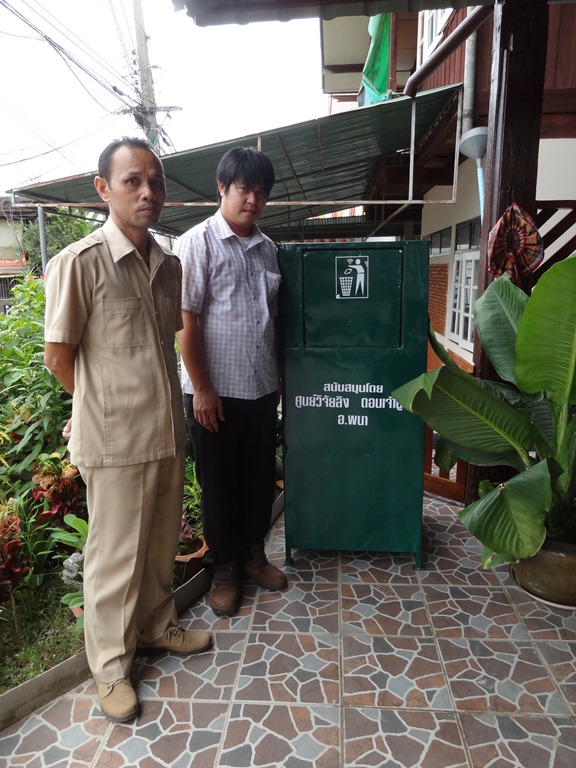
Phana District Hospital has had to confront the issue of monkeys raiding their rubbish bins and of course this is particularly important for a hospital which has some waste material that is potentially dangerous. So we turned to the hospital for help and the engineers there came up with this prototype for us and delivered it to the Research Centre.

2555-06-17 001 001          2555-06-17 001 002

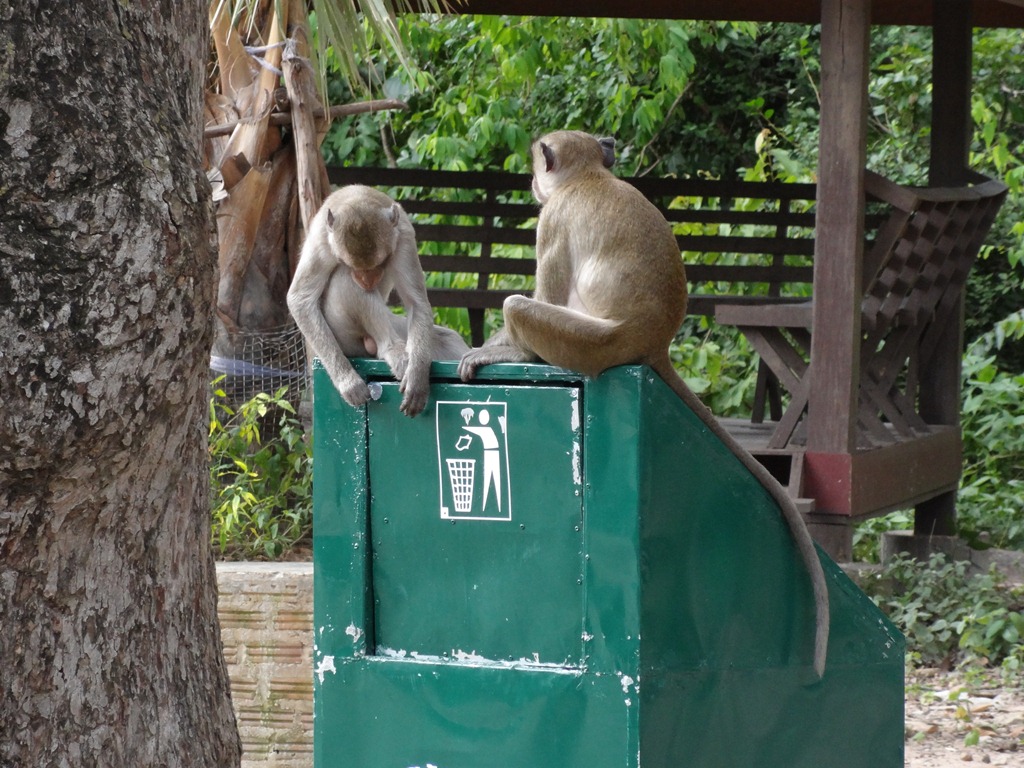
We placed it just inside the main entrance to the forest, where most of the litter accumulates. It attracted immediate attention from several adult male monkeys.

       2555-06-25 08-38-14_0064    2555-06-25 08-50-12_0086    2555-06-25 08-44-06_0080

Only male monkeys were at all interested in the bin and the second only climbed onto the bin when he was sure the first was no longer interested. The third monkey you see climbing up to join the second one was almost certainly a sibling and trusted by the older monkey. Several younger monkeys were chased away.

Below is an edited video showing the three monkeys on the bin, in turn, although you may not find it easy to distinguish between them. (I thought I had edited out the wobbly bit.)

We have since re-located the bin next to the tree and made it much harder to shake. These and other monkeys shake branches and anything else as a sign of ownership amd dominance, but in the case of waste bins it often results in them tipping over and emptying out the contents. This bin would only tip backwards from such shaking as you see here, so by placing it close to a tree we have hopefully prevented that happening.

Back to the drawing board, possibly.

Posted in Litter, Litterbins, Dustbins, Long-tailed Macaques, Macaca Fascicularis, Macaques, monkey forest, Monkeys | Tagged , , , , | Leave a comment

Distressed long-tailed macaque female in Don Chao Poo Forest, Phana

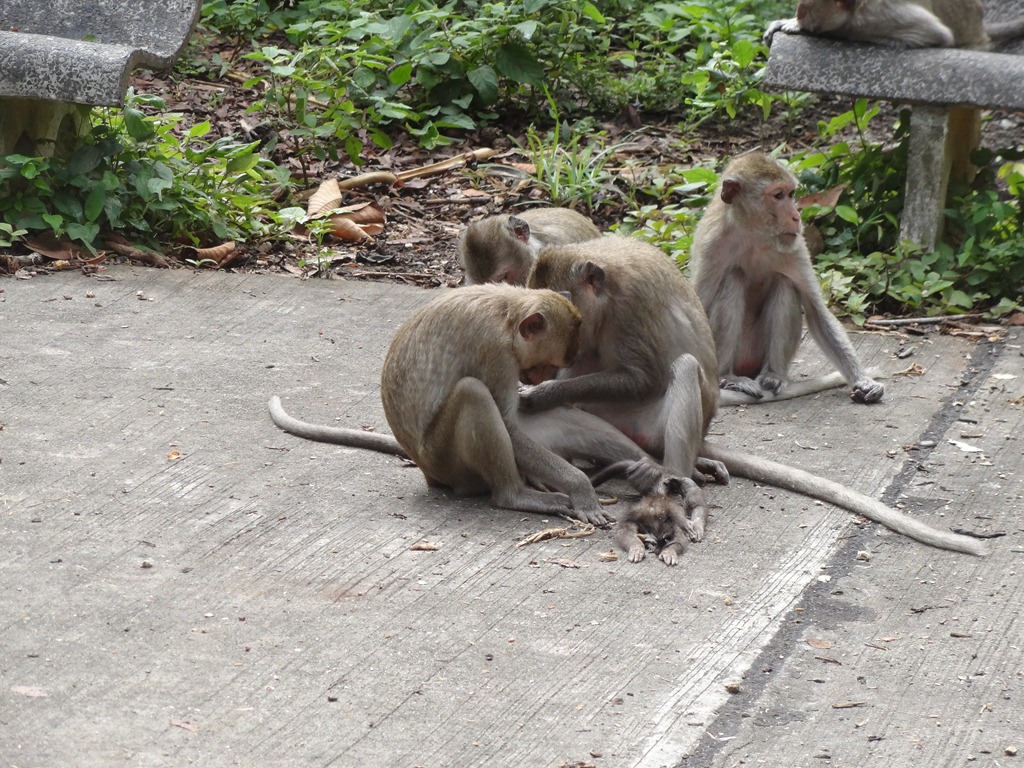
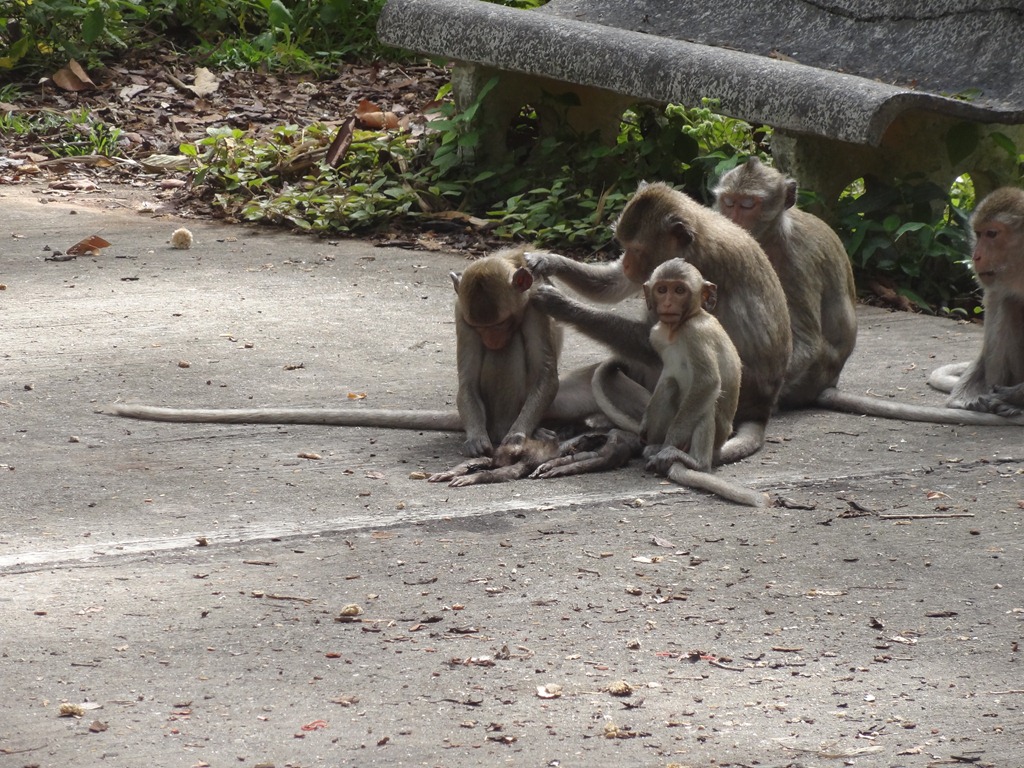
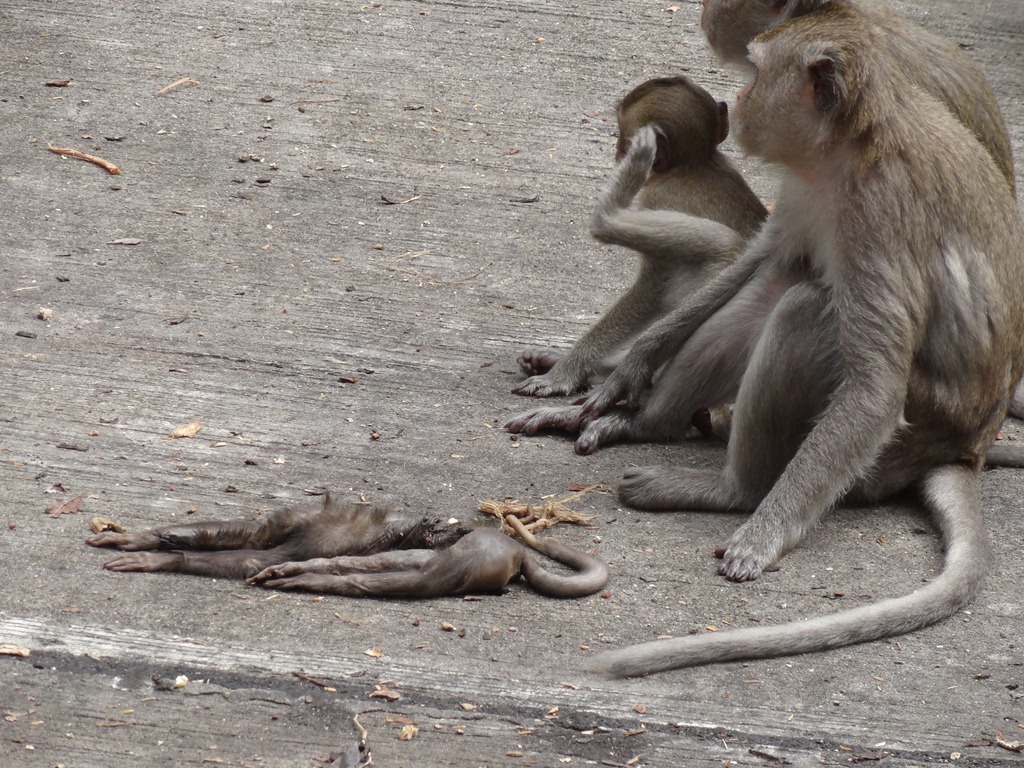
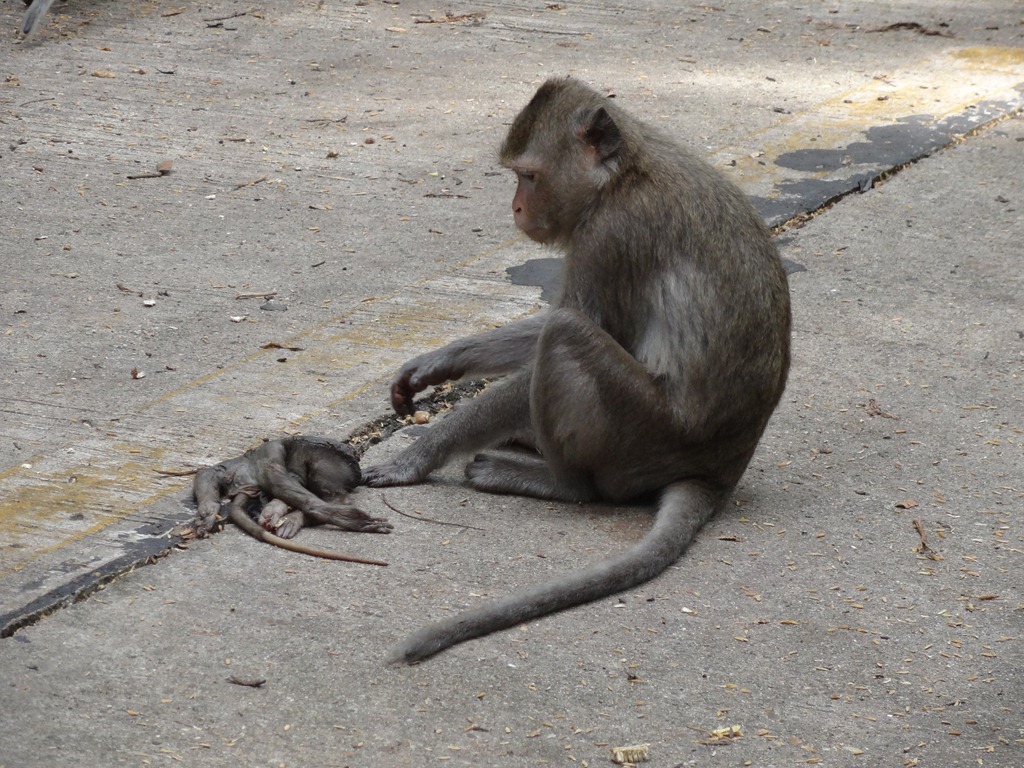
I was witness to a distressing scene in the forest a few days ago. I came across this group of monkeys which I took to be a family group. The adult female grooming a younger monkey had only just arrived, trailing with her a dead infant. The infant seemed wet and at first I assumed it had drowned, but as I saw it more I thought that it was so small and thin that it had perhaps been stillborn only moments before.

DSC03360   DSC03361   DSC03362

I assume that the monkey receiving the grooming was a female since it was adult and so unlikely to be allowed in the group if it was male. The low body position in the first shot suggests submission, since it doesn’t look at all comfortable, and the bowed head in the second shot also looks as if this monkey is unhappy – but perhaps I am just applying a human judgment here. This position is repeated in the following sequential shots.

DSC03363   DSC03364   DSC03365

Notice how the female (mother) doing the grooming is also retaining ownership of the dead infant by placing her left foot on the body.

The grooming did not continue for more than a couple of minutes before the mother was left on her own with the dead infant.

DSC03376   DSC03379   DSC03380

In these few minutes the body had dried and the mother also moved it around as you can see by comparing the last two shots with the previous ones. And after a minute or so more, she set off on a frantic journey backwards and forwards that seemed to indicate that she was deeply distressed. I switched to video and shot three sequences, although she made at least two more changes of location that I was unable to keep up with.

The monkey which sits down with her in the last shot is almost certainly the same one she was grooming earlier and most likely a sibling or even an offspring. The mother trusts her as you can see when she does not react to the infant’s tail being picked up and sniffed. .

This distressed macaque disappeared into the undergrowth and I did not attempt to follow her. Unfortunately I was not able to pick out any distinguishing features she might have so I don’t know whether or not I have seen her again

Posted in Long-tailed Macaques, Macaca Fascicularis, Macaques, Monkeys | Tagged , , , , , , | 2 Comments

Long-tailed macaques in Phana as seen by Elliot Capp – ace photographer

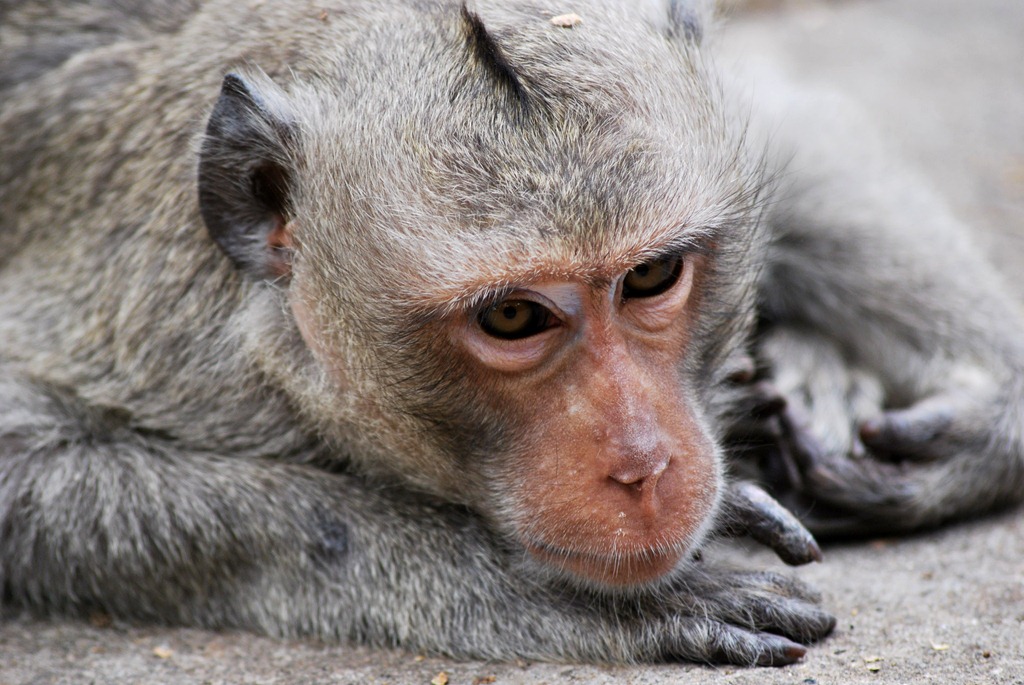
One of the four researchers who came as volunteers to Phana earlier this year after completing their MSc degrees in Animal Behaviour at Exeter University was Elliot Capp. He left us with over 1500 photographs and I think I know each one of them now. They are so good that I look through them frequently. I have used about 150 of them as the core of the exhibition of long-tailed macaques that illustrates the natural history of these monkeys and some of their most frequent behaviours. As a kind of sideshow, I have chosen 18 portraits from the many superb pictures Elliot took.

Here are the 18 that I chose, but believe me, I could have multiplied the number several times. Please CLICK on the images to see them at their best.

B0000240B0000242B0000847IMG_4658IMG_4950IMG_4964IMG_5093IMG_5262IMG_5803IMG_5977IMG_8036IMG_8076IMG_8120IMG_8197IMG_8259IMG_8305IMG_8331IMG_8373


I will be putting up more photos by Elliot Capp very soon. The problem I have is that it is so hard to limit the number and also to show the range of macaque behaviours he was able to capture. In addition to that, he also took pictures of butterflies, birds and a monitor lizard devouring a frog – not to be missed!

Posted in Long-tailed Macaques, Macaca Fascicularis, Macaques, monkey forest, Monkeys, wildlife photography | Tagged , , , , | 1 Comment

Monkey-proof dustbins in Singapore and Phana

Waste disposal is a world-wide problem. Developed countries are having to reduce the frequency of garbage collection from households and businesses. Developing countries have to come to terms with the ever-increasing amount of garbage that their societies are producing and disposing of. In a country like Thailand which has traditionally wrapped and sold small food items in banana leaves, the alternative use of  plastic bags has been seen as a sign of ‘civilized progress’ to such an extent that now (at last, many would say) authorities and communities are having to face up to the fact that plastic bags do not disappear as banana leaves do.

Recycling is the buzz-word that is beginning to be heard more frequently in small rural communities like Phana and significant steps have already been taken to recycle more and more of the waste we accumulate here. We are also a model for ‘zero waste’ practices that are slowly being introduced nationwide. And yet in Don Chao Poo we have significant problem and a relatively rare one, I imagine.

Phana is proud of the monkeys of Don Chao Poo and the forest itself but we are struggling to contain the waste that accumulates in the forest. Struggling, but winning the battle. Last year, a small band of volunteers filled 110 large black bin bags with litter picked up in the forest. This was litter that had accumulated over several years and much of it had been swept into the undergrowth with leaf litter in the clear-ups which precede municipal events in the forest. Most of this litter is associated with the monkeys. Food for the monkeys is brought into the forest in plastic bags and often the monkeys will snatch these bags and make off with them. When litter has been placed in dustbins it  has later been raided by the monkeys and taken as playthings into the deep parts of the forest. A small amount of the litter has been human-related – some people go into the forest and spend time in one or other of the wooden salas, drinking from cartons, eating packaged crisps, smoking cigarettes and disposing of the empty packets, and so on.

This year, the ‘litter problem’ is being kept under control. The municipality have given the responsibility of clearing litter to two men who visit the forest for a couple of hours every day. On two or three days a week they also scatter unhusked rice for the monkeys. Most of the dustbins have been removed because although they were used they were not often emptied, or at least not before the monkeys themselves had emptied them and spread the contents far and wide.

But dustbins ARE necessary to store litter temporarily, and there is evidence that most of the visitors who come to feed the monkeys would put their plastic bags in a dustbin if there was one nearby.

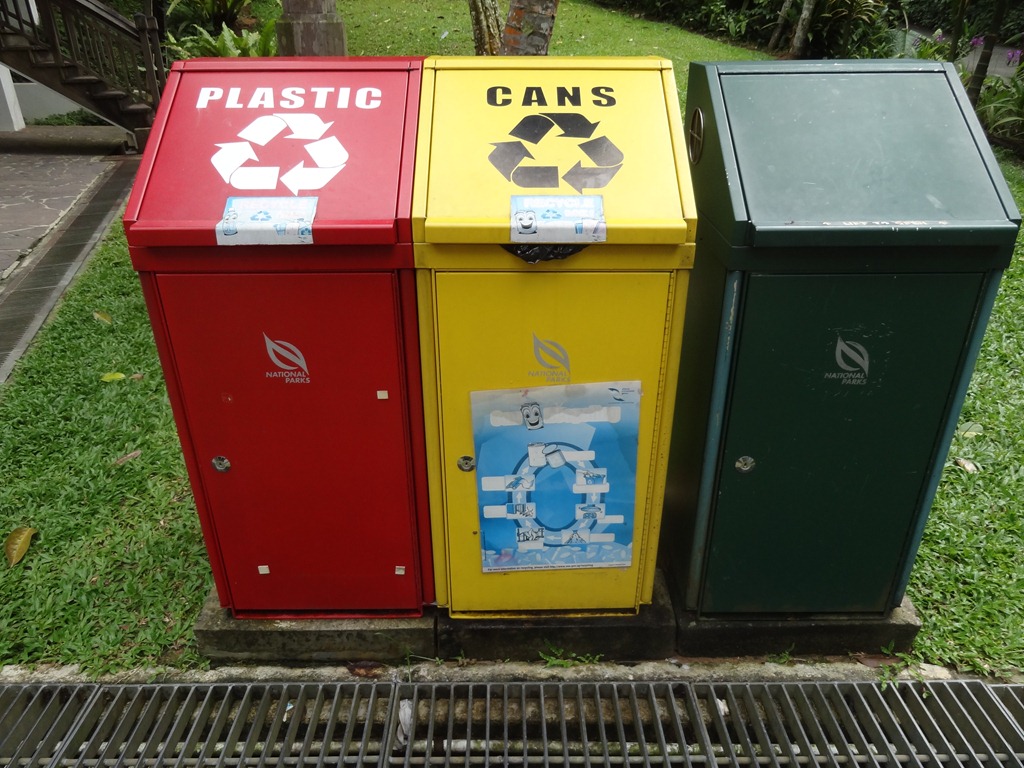
So the search has been going on to find a suitably monkey-proof dustbin. Singapore is supposed to have cracked the problem, a much bigger one for them because they need to provide monkey-proof bins or residents living within the home range of a large number of monkeys. Residents of Singapore are not so sure that their bins are truly monkey-proof, but from what we have seen they are a great improvement on most of the bins in Phana.

We saw two models. These were at the McRitchie Reservoir Park.
 DSC02588     DSC02589

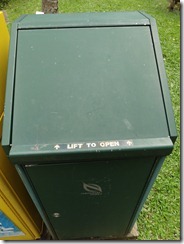
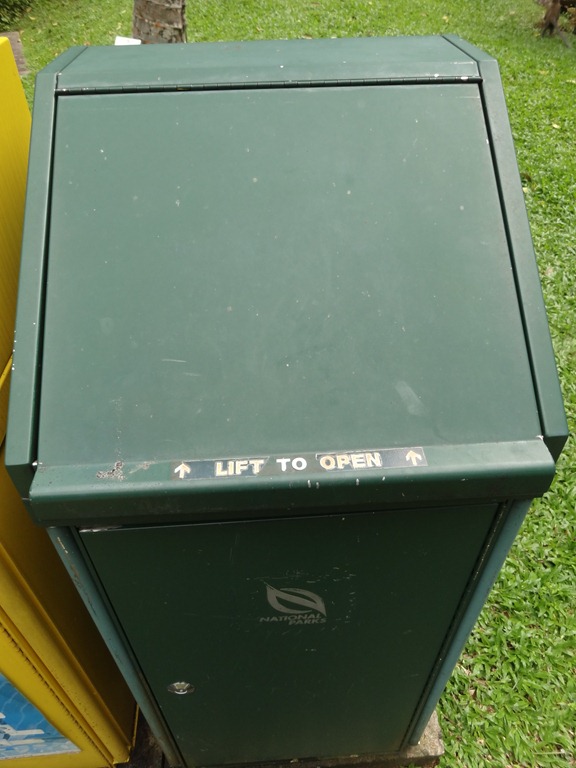
The large lid and narrow surround to it provide only a small foothold for a monkey and the weight of the lid makes it very difficult for a monkey to open. However, there are some reports of two monkeys seemingly working together who have managed to gain access to the garbage inside. It seems likely that the two monkeys are not working co-operatively but both want to get at the garbage.

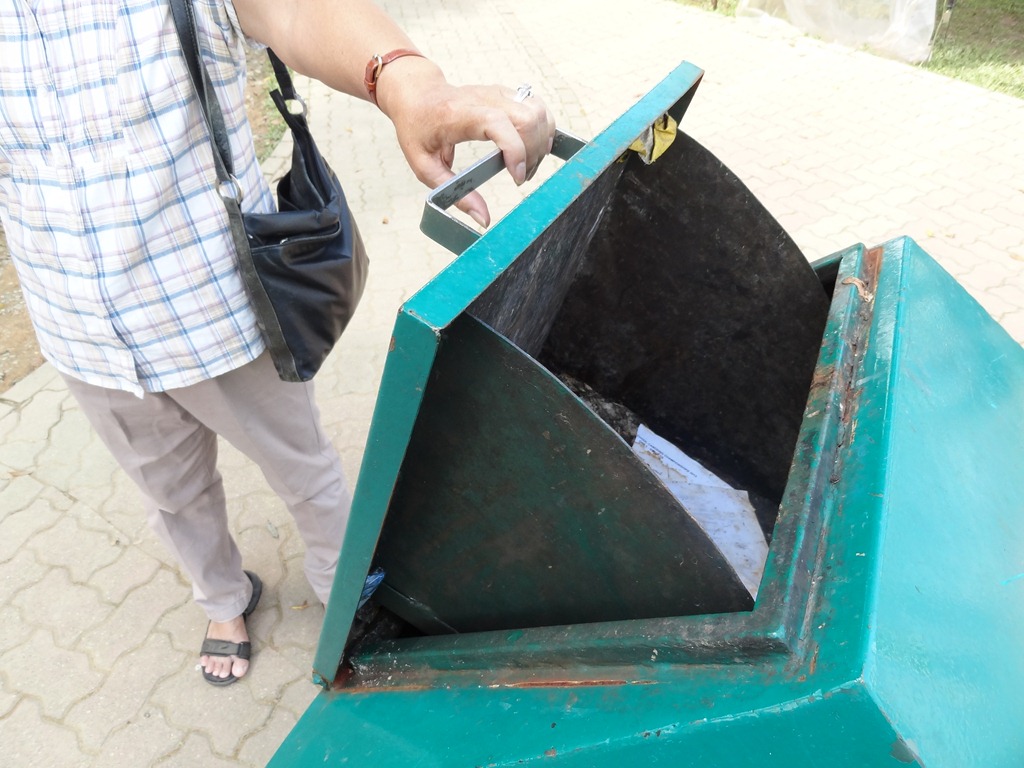
Here is a different, older model

DSC02672    DSC02670    DSC02671

DSC02663   DSC02665   DSC02666

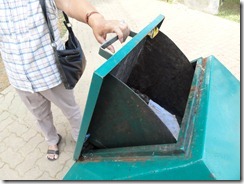
Nor this bin does seem to be truly monkey-proof as you can see from the lower three pictures. However, on some forums I have read people complaining that the handles become fouled by monkeys, birds, anything to provide an excuse for not using them, perhaps. If a monkey did succeed in opening this bin, it is most likely that it would then fall into the bag below and be trapped there.

How often do you go searching for something that later you find has been right under your nose all the time? Not long after we got back from researching bins in Singapore, a visit to Phana District Hospital led us to these:

DSC03405   DSC03406   DSC03407

Phana District Hospital was built on land that was previously designated as part of Don Chao Poo Forest. The monkeys still think it is part of the forest, and anyway, like nomads everywhere, they don’t recognize borders or take any notice of them. We asked the Director of the hospital, Dr Patamapong, about the bins and he said that they had been made by the maintenance staff of the hospital and that they were in the process of designing and producing an improved model. In fact, this model seems pretty good to me. There is very little purchase for a monkey planning to get at the contents of the bin, and the flap swings heavily on the hinge at the top and as with the second of the Singapore bins, the internal storage in a black bag is below the reach of a monkey. Again, perhaps, there is the possibility of a monkey getting in but not being able to get out, but this possibility seems very remote.

We are now going to liaise with the hospital staff and we will work together on a new and hopefully improved design. The hospital needs to replace these bins even if the design does not change. And they have offered to produce bins for us to place in Don Chao Poo, whether the design is the same as theirs or not. So we may be on the way to making further progress in keeping Don Chao Poo a clean and pleasant place, albeit we will be limiting or eliminating one of the pleasures that the monkeys now enjoy: playing with plastic bags and spreading them around the forest.

Posted in Litter, Litterbins, Dustbins, Long-tailed Macaques, Monkeys, Research, Tetsaban Phana | Tagged , , , | Leave a comment

More of the Thai Monkey Forest Fauna

Long-tailed macaques (Macaca fascicularis) are the most obvious inhabitants of Don Chao Poo Forest in Phana, but they are not the only ones. Two other species which generally make themselves scarce when people are around, can be seen by someone who is patient and quiet and does not move around too much. You also have to know where they are likely to be seen and at what time of day. One of these species is considered a delicacy by local people and fetches quite a good price in the market, and although the original intention some fifty years ago was that Don Chao Poo  should be an animal sanctuary, they are not considered ‘children of Chao Poo’ and so are likely to be ‘harvested’.

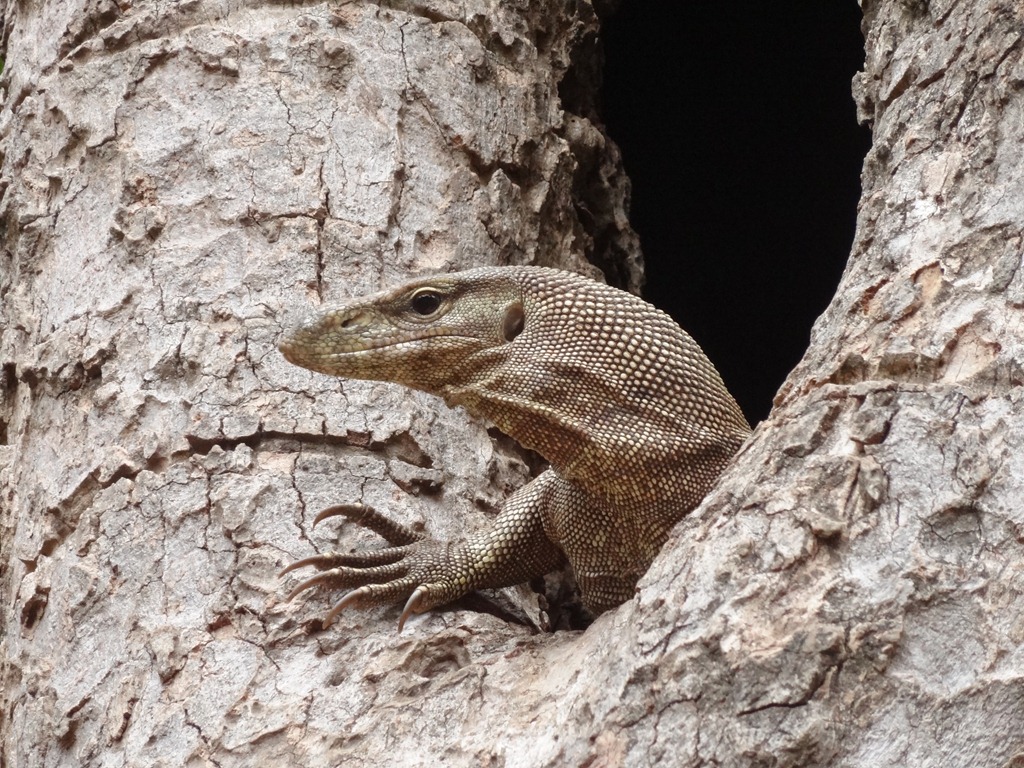
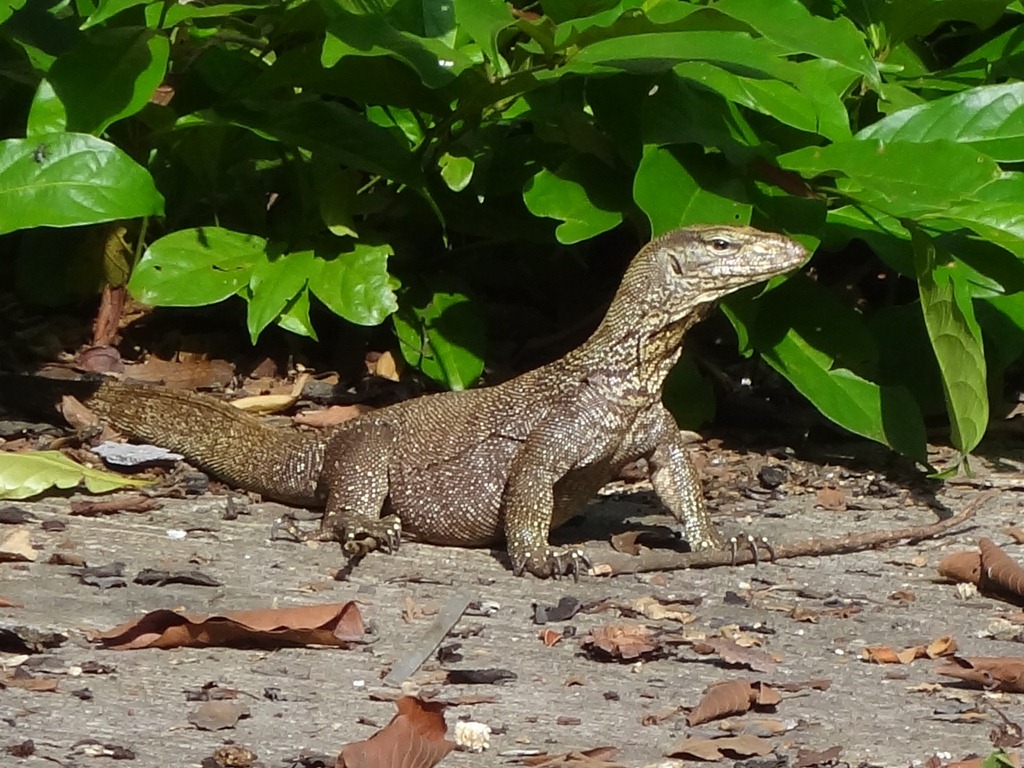
I am pretty sure that there are at least two pairs of Bengal monitor lizard (Varanus bengalensis) in the forest and one appears to be pregnant. This is the first sighting I had of one, a few months ago:

DSC02338

Since then I have seen one or other of them on the ground on several occasions:

DSC03277

DSC03284

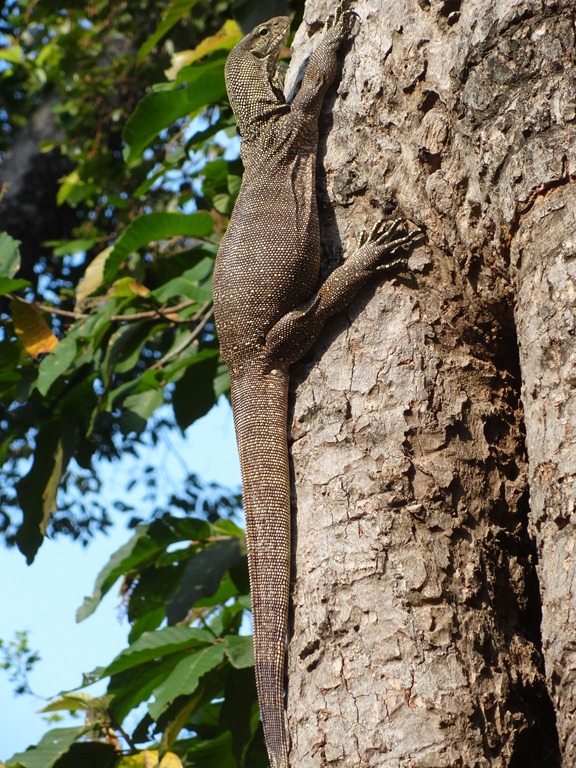
and climbing trees. This species has been described as “an adept tree climber and thus a formidable enemy to nesting birds and squirrels” (Mark Graham & Philip Round, Thailand’s Vanishing Flora and Fauna, Finance One Public Company Ltd, 1994):

DSC02959

The specimen shown above and below has the appearance of being pregnant, and I have not seen her now for several days, so I am now on the look out for evidence that she has given birth. I don’t suppose that the offspring will be visible for some time but there may be evidence from changes in the pair’s routine.

DSC03282

Fortunately she seems to have an affectionate and attentive partner:

DSC03256

The other species I have been aware of for much longer but until recently have not been able to get near enough to take reasonable photos. Even now, this is as near as I have been to them:

DSC02876

There seem to be two groups of about the same number in each (8-10) living about 150 m apart. Enlarged photos indicate that they are Indochinese ground-squirrel (Menetes berdmorei):

DSC02884

DSC02891ADSC02893

Posted in guardian spirit, Indochinese ground squirrels, Long-tailed Macaques, Macaca Fascicularis, Monitor lizards, monkey forest | Tagged , , , , , | 2 Comments

Long-tailed Macaques in Singapore–a different approach

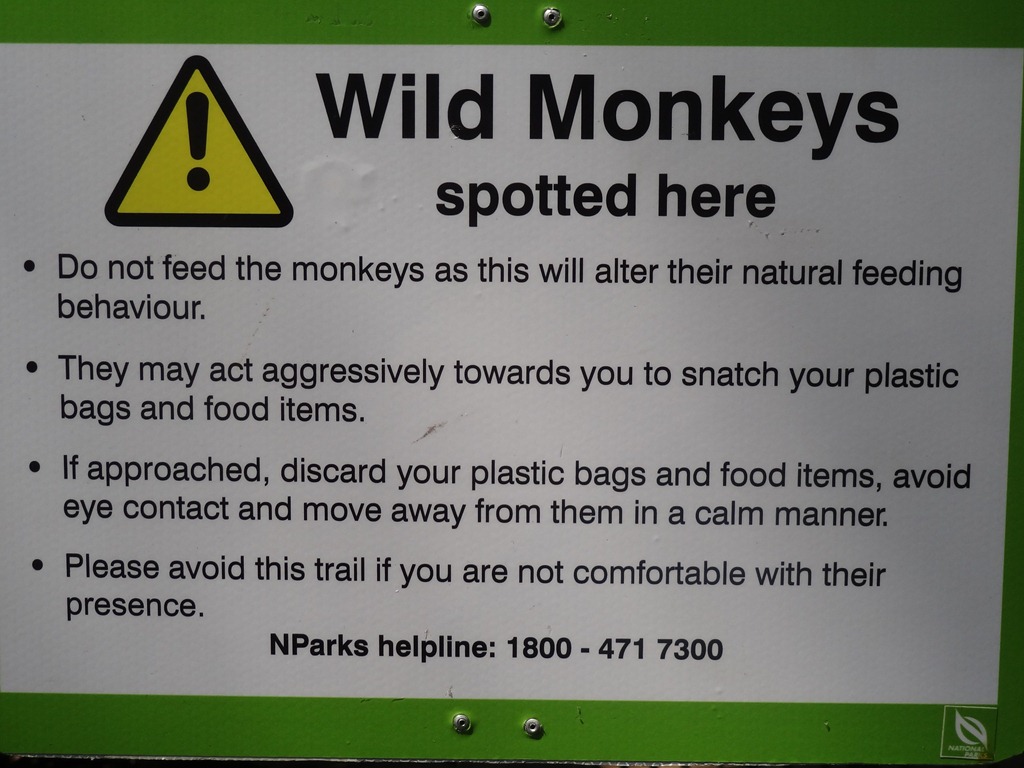
Our recent trip to Singapore threw up some similarities but more differences concerning the long-tailed macaques there and here in Phana. In Singapore the macaques seem to be perceived as a ‘problem’ at least by the powers-that-be and presumably by the majority of people that those powers represent. Indeed, they seem to be regarded as a threat, and they are frequently referred to as ‘dangerous’. This notice is one example of this:

DSC02713

Points 2, 3 and 4 seem designed to scare people – people who are using open-spaces and parkland for their leisure, it should be remembered. There is nothing in those points that I would disagree with but the emphasis does seem to be tilted in such a way that the monkeys are made to sound villainous.

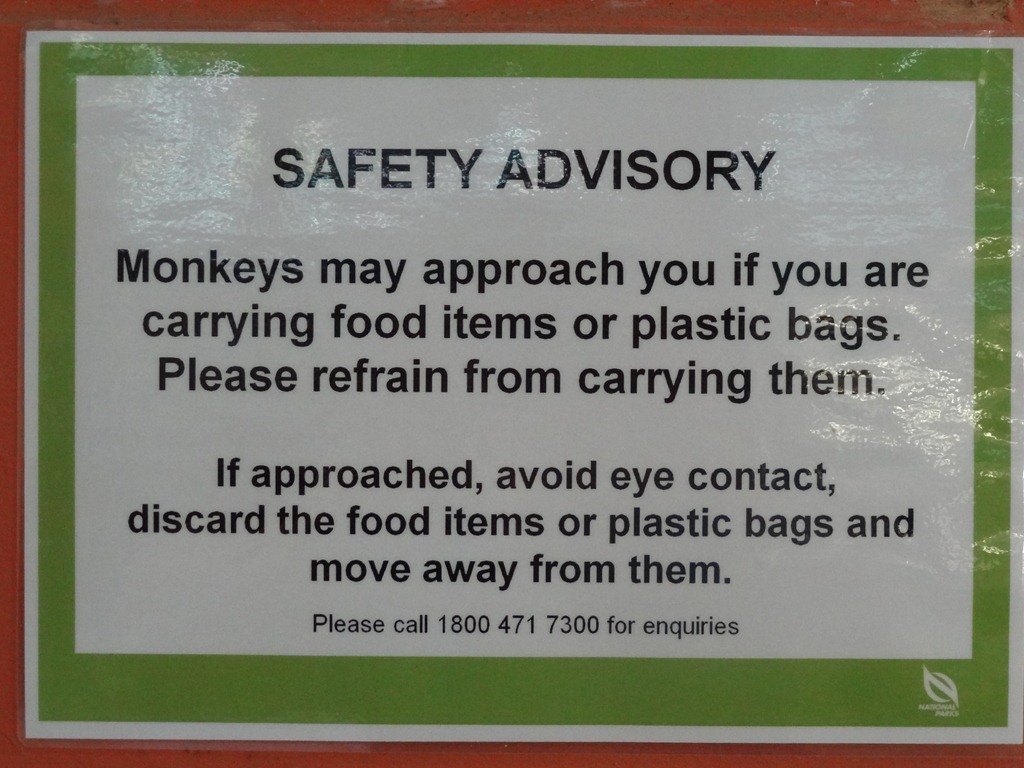
This notice again gives good advice but again puts the blame for the situation on the monkeys: DSC02656

Elsewhere we found this series of notices, which again are giving good advice but doing so in terms that are more sympathetic to the monkeys.

DSC02639DSC02640DSC02641DSC02642

The blue sign, in particular, seems to be shifting the ‘danger’ from the monkeys to the humans.

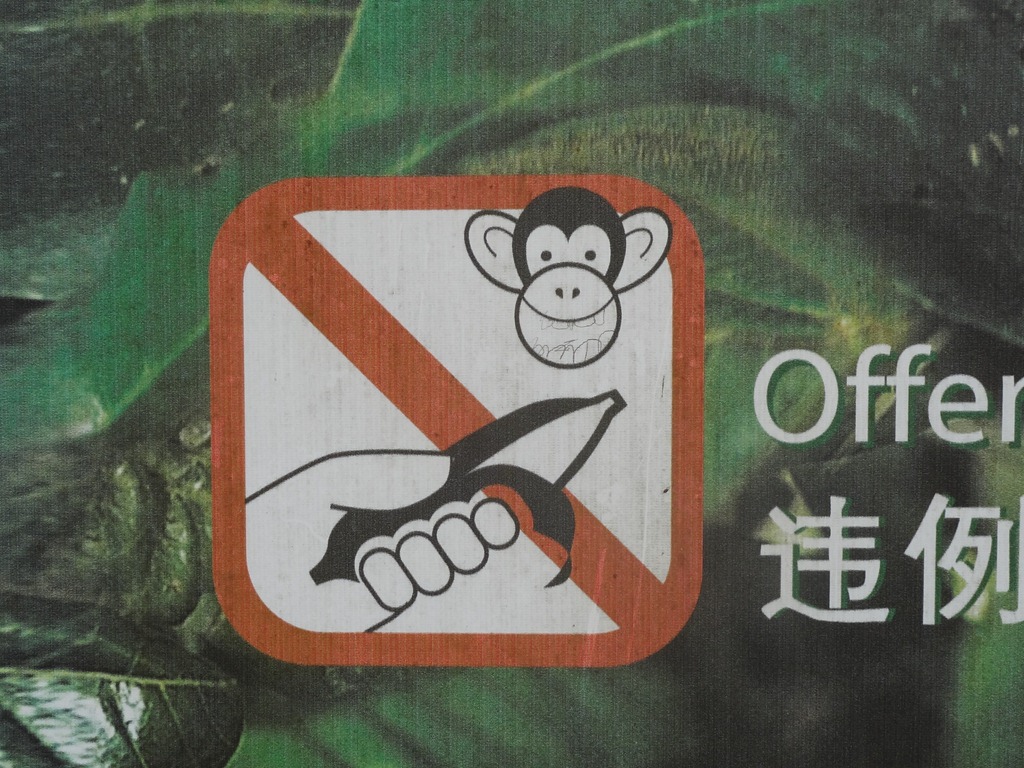
Feeding the monkeys, or more accurately, NOT feeding the monkeys is a particular concern as these notices show:

DSC02643DSC02644

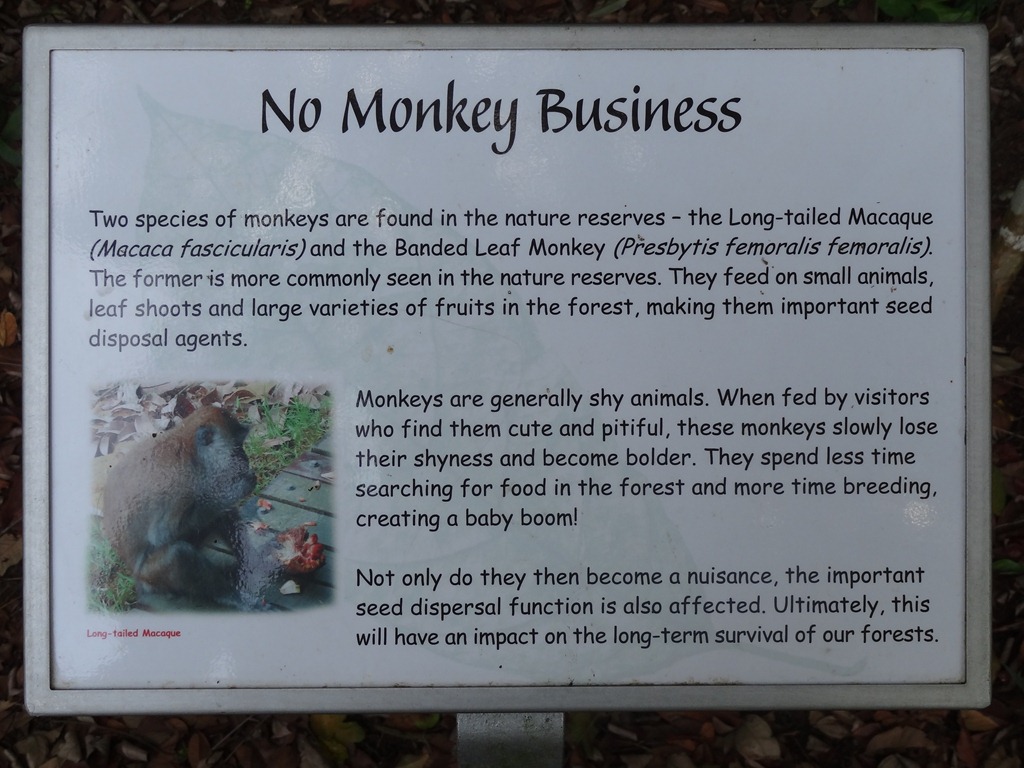
This sign, seen at McRitchie Reservoir, explains much more  fairly the reasons for not feeding the monkeys:

DSC02705

Nevertheless, the words ‘not only do they then become a nuisance’ sum up the way the long-tailed macaques are regarded. And not without reason, it must be said. They raid dust-bins and invade gardens and they enter people’s homes if they can (if a window is left open, for example). But they do this not only because they have lost their shyness and developed a taste for human food. Their own territory has been invaded by the building of houses and apartment blocks right next to the forests that are part of their home range. And long-tailed macaques are curious, inquisitive, playful, and they love living alongside humans.

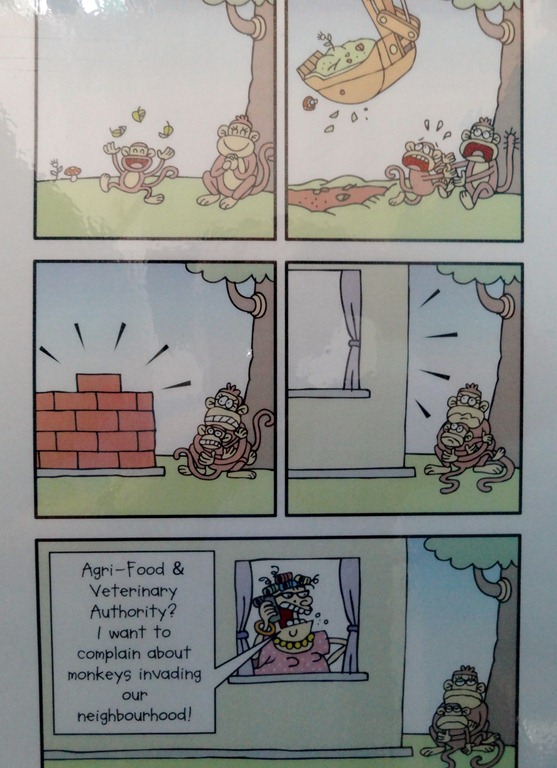
Here is a cartoon which I found fly-posted in several places. Click on it to enlarge it for a clearer view of its message.

DSC02706

More evidence that some people in Singapore do still find the monkeys ‘cute and pitiful’ is that despite the notices people are still being prosecuted and fined.

Now I am in no way advocating that people feed the long-tailed macaques in Singapore. There is plenty of forest for them to forage in and find food which it is natural for them to eat and in quantities that will not result in a baby-boom and the culling that that would almost certainly follow.

But at the moment, the situation here in Phana is a very different one in most respects. Any attempt to stop people feeding our monkeys would be complete failure (there are signs next to the forest threatening a 2,000 Baht fine for littering, but it makes no difference at all and certainly nobody has ever been asked to pay that fine). And the truth is that we need to continue feeding the monkeys at the forest because they are now so habituated to human provisioning that if we stopped they would surely range into the village, into the town, and invade restaurants and homes in search of the food they have come to depend on. They still forage in the forest on days when no food is provided, or not enough to go around. They have not become aggressive and have not taken to attacking visitors they suspect of having food with them. But they HAVE produced a baby-boom, and this is a problem which I fear will have to be addressed before long. I am sure that given the reverence that local people have for our long-tailed macaques as the children of the village’s guardian spirit, the problem of over-population will be approached in the most humane way possible.

Posted in guardian spirit, Long-tailed Macaques, Macaques, monkey forest, Monkeys | Tagged , , , , | Leave a comment

Long-tailed Macaque Twins in Don Chao Poo Forest

Ten days ago I saw a monkey carrying two young infants. The infants looked to be the same age but I had never seen twins in the forest here before. I know that sometimes a female will foster an orphaned infant, so that is a possibility too. At the time I did not have my camera with me, and my sighting of the mother + two was quite brief.

I have been on the lookout for them ever since, and today I finally succeeded. And I had my camera with me.

They look like twins to me. What do you think? And have you come across long-tailed macaque twins in the wild before?

Click on the images for an enlarged view.

DSC03099DSC03100DSC03101DSC03102DSC03103DSC03106DSC03112

This post also appears at Life in Phana. Please visit that site if you would like to know more about life in lower Isan.

Posted in Long-tailed Macaques, Macaca Fascicularis, monkey forest | Tagged , , , , , , , | 1 Comment

Mapping the forest

Guest blogger: Robin Southon, MSc Animal Behaviour, Exeter University, UK

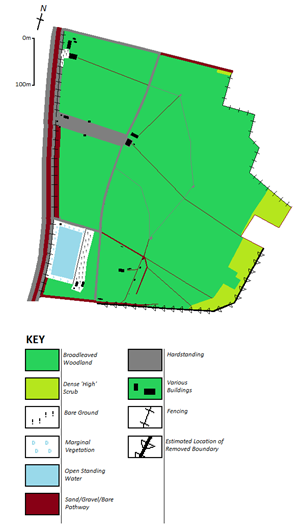
When our group from Exeter first arrived in Phana, we decided to familiarise ourselves with the forest and macaques by conducting a time budget analysis of the population. This is a common technique in animal behaviour, and would allow us to learn how individuals, separated by age and sex, differ in daily activity, taking into account the time of day, habitat and location. This investigatory study would then allow us to ask more narrowly defined questions from observation. Two problems arose from this: (a) we wished to randomly sample our population, but had no idea of the macaque distribution or forest layout, and (b) we did not know what habitats occurred on site. To tackle this problem, we would need to create a map of the forest, which would then allow us to overlay a randomisation grid, in addition to showing us local habitat types. This would not only help us with the time budget analysis, but provide the Phana Macaque Project with a map and an initial assessment of the habitats located on site.

As is typical in research, it was not so simple, and another problem arose. The only source map we had of the site was a low-pixelated image from google.com map service. However, this at least gave us a rough outline of the site, and luck was at hand in the form of a tape measure and GPS device. Using the GPS device, the distances of the paths and parameter of the site was recorded, with shorter distances recorded using the tape measure, due to the +/- error of 5 to 10metres of the GPS device. These measurements were then pieced together using ImageJ, a rather handy tool from http://rsbweb.nih.gov/ij/. The result was our first attempt at accurately mapping the forest. It may not be the prettiest of maps, but it did the job of providing us an outline for our random samples, and landmark awareness for locating the grids.

The map then needed to be filled in with habitat types. To do this certain elements normally used to  conduct British Phase I Habitat Surveys was used, but differed slightly due to the situation on site and local habitat descriptions. Doing a walkover of the site a judgement of habitat coverage was taken, documented in detail, and a habitat map produced. The only thing missing from the documentation is inclusion of a personal risk assessment… seing that you are most likely to get sunburnt on the open bare ground, mobbed by macaques on the hardstanding, thrown off your bike by vines in the woodland, and attacked by various sharp-thorned plants in the dense high scrub!

(CLICK on the image below to get a larger view.)

imageNow that we have a Phase I guide to the site, what’s next? The obvious next step would be to conduct a more detailed assessment of the habitats in our grid locations by placing transects and taking samples of flora & fauna, along with tree surveys, but we are limited at the moment due to the lack of knowledge on the local flora. That will hopefully be solved with help from the forestry department, and because we have the map and the grid location from our time budget data, we can then match the time budget and habitat data together. Another more immediate possible study to conduct is to plot the macaque population distribution onto the map, which then might be useful as a guide for knowing how the population disperses throughout the day.

I hope this small informal report sheds some light on what is happening within the Phana Macaque Project, and we hope to report on some more detailed data later on in the process. Thanks for reading.

– Robin

Posted in Long-tailed Macaques, Macaques, monkey forest, Monkeys, Research, Uncategorized | Tagged , , , , , , , | Leave a comment

Phana Monkey Project

 RESEARCH TEAM

The Phana Monkey Project is about to reach a crucial stage. A week from now five  researchers, all recent Msc graduates in Animal Behaviour from Exeter University in the UK, will arrive in Phana to begin a  project which will provide the basis for  the establishment of Don Chao Poo Forest as a research field site as well as educational and informational material for schoolchildren and visitors to the forest.

This team will be carrying out most of the research which you can find listed on the RESEARCH page on the bar above. In addition, they will be conducting some research of their own along lines that they discussed last Friday with Dr Joah Madden of Exeter University. Details of their research will appear on this site.

NO APE MUSEUM

As far as the Phana Monkey Project goes, we have not been idle in the last few months. We have held meetings with the Phana Municipality to clarify our role and theirs. At least one of the original intentions has been abandoned: the money is no longer available for an “Ape Museum” to be built in the forest. Although the promise of this was perhaps the key starting point for the then-named Macaque Project, I think all of us who have carried the idea forward see abandoning that particular part of the project as a good thing. There was every chance that had a building been provided, there would have been no money available to keep it staffed and maintained; on top of that, building inside the forest would have been a major disruption. There are already two small buildings in the forest which have been abandoned and left to the monkeys to play in — their main playthings being ceiling and roof tiles, which they love to pull off and destroy.

COMMUNITY CENTRE

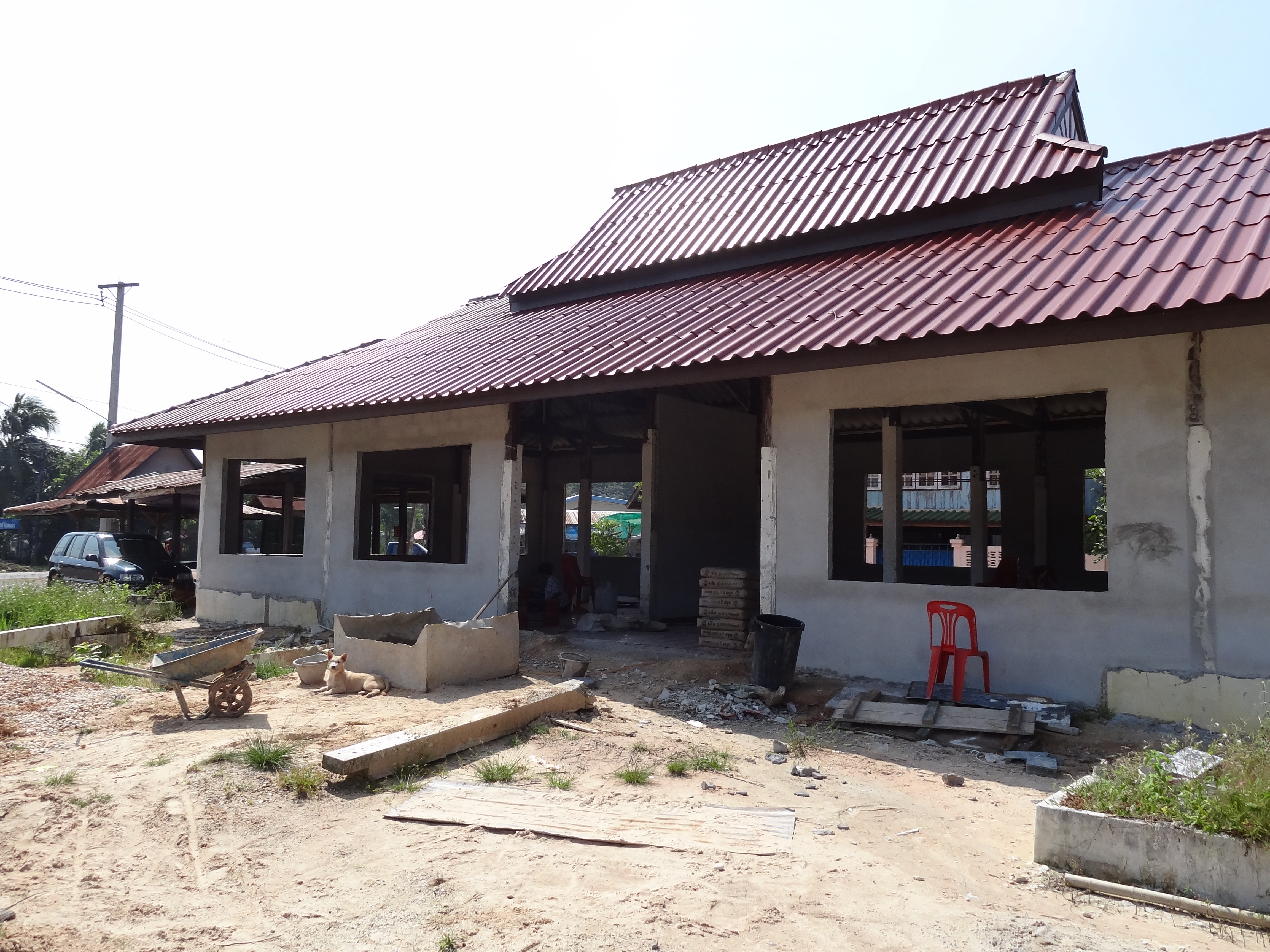
The Tetsaban have suggested an alternative to an ‘Ape Museum’ in the forest. The old market building is to be converted into a kind of community centre, and it will provide three main spaces. At one end will be a community IT centre with 22 computer stations. There will be a similar-sized space at the other end of the building which we will be able to use to show videos to visiting schoolchildren. The central space will be for occasional community meetings, and we will provide an exhibition detailing macaque information and photographs in that space.

The tetsaban is providing the materials for the conversion of this building but the community will provide the labour. In the following pictures you see the headman of Moo 7 and his wife working on the new floor, which they have completed since the photos were taken.


CLEANING UP THE FOREST

Last week we worked with the tetsaban / municipality and some students from the school they run, to clear the forest of litter. It is amazing how quickly litter accumulates, and monitoring it will be an important focus of the upcoming research, so that hopefully we can recommend some practical ways to reduce the litter produced and ensure that litter is removed frequently. Our monitoring will be made more useful because we have established a ‘zero-litter’ environment before the monitoring begins. This way we should be able to get a clearer picture of when, where, and how much litter is dropped over a weekend, for example. Already the tetsaban have put a new cleaning team in place to collect and remove litter and we are sure this will be a great improvement on the previous ’emergency’ cleaning sessions before big events.

DON CHAO POO FOREST RESEARCH CENTRE

The Phana Monkey project has also been working to provide a centre for researchers to use while they are in Phana, and the team from Exeter University will be the first to do so. The building is almost ready, and the only thing which may prevent them moving in as soon as they arrive is that water and/or electricity may not be connected in time. Details of this centre will appear here as soon as all is ready.

ROAD TRAFFIC FATALITY

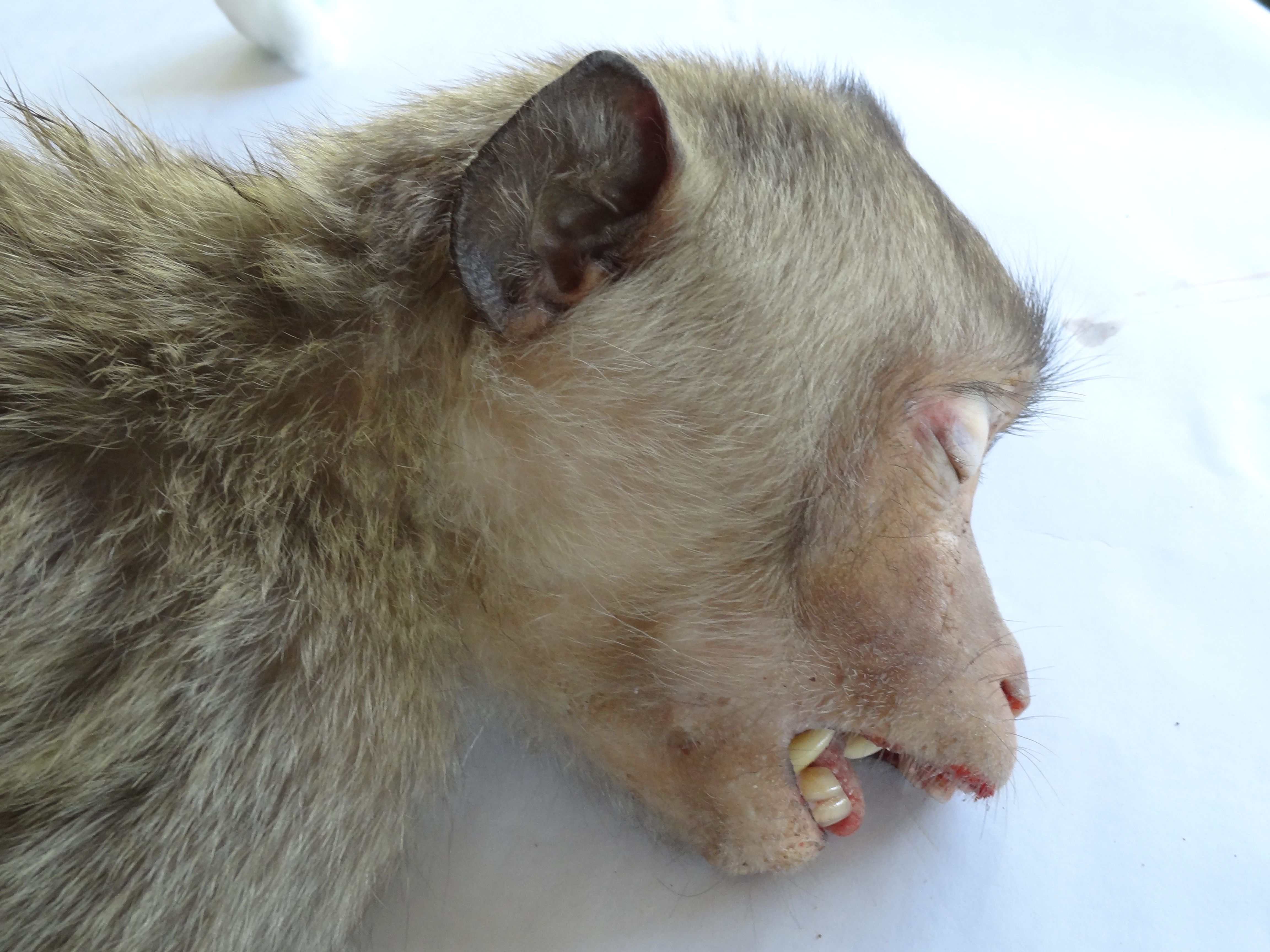
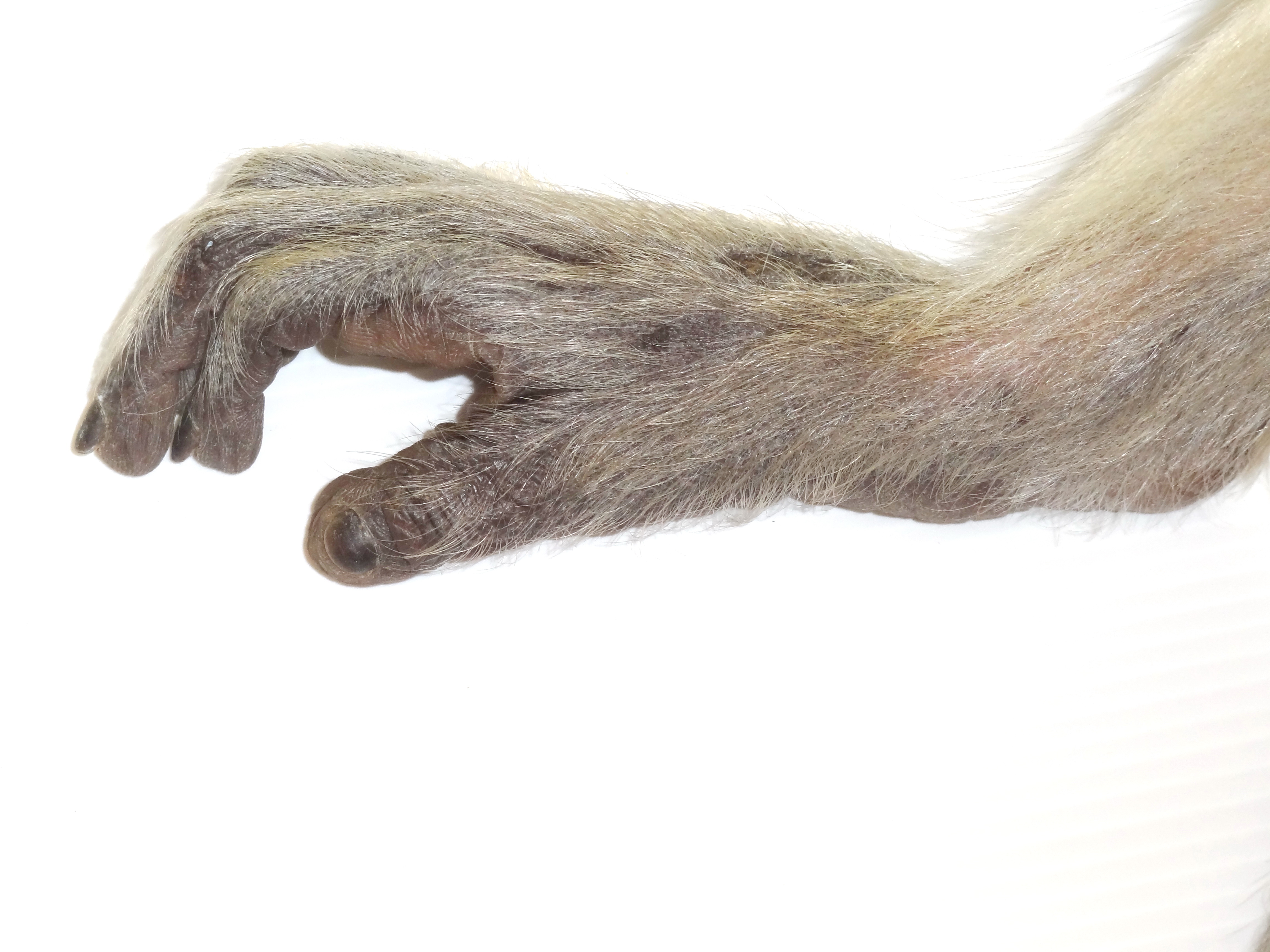
Last week we experienced our first recorded road traffic fatality, an adult male killed on the road outside the forest just before 8 am. As it happened, Pensri and I were on our early morning cycling exercise, so Pensri put the still-warm monkey in a plastic bag (there were still plenty lying around at the beginning of the week) and took him home. Our first thought was taxidermy but it quickly became apparent that no-one locally had the skill and experience to do this; we soon realised, too, that there was litle point in creating a life-like specimen when we have more than 400 live ones! With advice from Prof Dr Suchinda at Chulalongkorn University, we decided to preserve and display the skeleton. The person in charge of the museum in the Biology Department at Chula sent us some insects (in a box, via the Railway parcels service) and for more than a week now these insects have been nibbling away at the cooked flesh and revealing more of the skeleton. When the process is completed we will post pictures of the skeleton and more detail regarding the process. For the time being, here are a few of the photos we took of our monkey soon after the accident. The monkey had been hit a glancing blow on the side of the head which had fractured his skull but not smashed it. Nevertheless, bleeding was still evident through his nose and mouth, so no pictures of his injury are included here. The blow struck him on the left side of his head, the side not shown here. He was a fine specimen as can be seen from his teeth. (CLICK on the photos for an enlarged view.)

Posted in Amnat Charoen Province, Long-tailed Macaques, monkey forest, Research, Tetsaban Phana | Tagged , , , , , , , | 2 Comments

Disturbed forest, disturbed monkeys

The long-tailed macaque is said to prefer to inhabit ‘disturbed forests’. Don Chao Poo, or the monkey forest, here in Phana is certainly disturbed. It has been disturbed by installing four large Buddha images, and paving the sandy paths to them; by widening and concreting some of the sandy tracks, converting them into roads; and by building several toilet blocks and installing water tanks and water troughs. Cars, pick-ups and motorcycles make use of the roads and cause more disturbance. Visitors walk into the forest to feed the monkeys or just to look at them.

And the thing is, the monkeys do obviously love all this. When I walk into the back of the forest, to the undisturbed parts away from people, traffic and buildings, there are no monkeys to be seen. Possibly they use this area for sleeping, but I doubt it. When I have seen the monkeys coming down to the ground early in the morning it has always been from trees close to the road.

The ceremonies and celebrations held in the forest at certain times of the year are a major form of disturbance. But again, the monkeys seem to love these occasions. Often they stay out of sight while most of the ceremonial activity is going on, but the people who come to the forest and the food they bring with them attract their attention and the monkeys are just waiting for most people to depart and then they start scavenging the left-over food and bags and so on.

Just recently the forest has seen the annual retreat by monks, mae chee, and some lay people, about 200 people altogether camping in the forest for 10 days of meditation and Buddhist teaching. Every morning they go on alms round, and the lay people who offer the food stay to eat a late breakfast/early lunch in the forest. The monkeys stay away but they are alert to any chance to do a bit of scavenging.

I took a walk around the ‘Buddha image trail’ with some Thai friends and a young woman from Guatemala who had come to Phana with them. On this occasion there were several monkeys on and around the path, something I haven’t seen before. They were there either because their usual places had been taken over by the monks, or perhaps because there were more humans than usual using the path. And as well as disturbed forest, long-tailed macaques love to be near humans, in the hope of getting some food, mainly, but also it would seem that they like our company as much as we like theirs.

Here are some of the monkeys I met that day. You can click on the images to enlarge them.


So the forest is disturbed and the monkeys are disturbed, but they seem to take it all in their stride. It’s all part of the experience of being a long-tailed macaque in Don Chao Poo Forest, Phana.

Posted in Ceremonies and Celebrations, Long-tailed Macaques | Tagged , , , , | 1 Comment