Injured Monkeys, Part 1

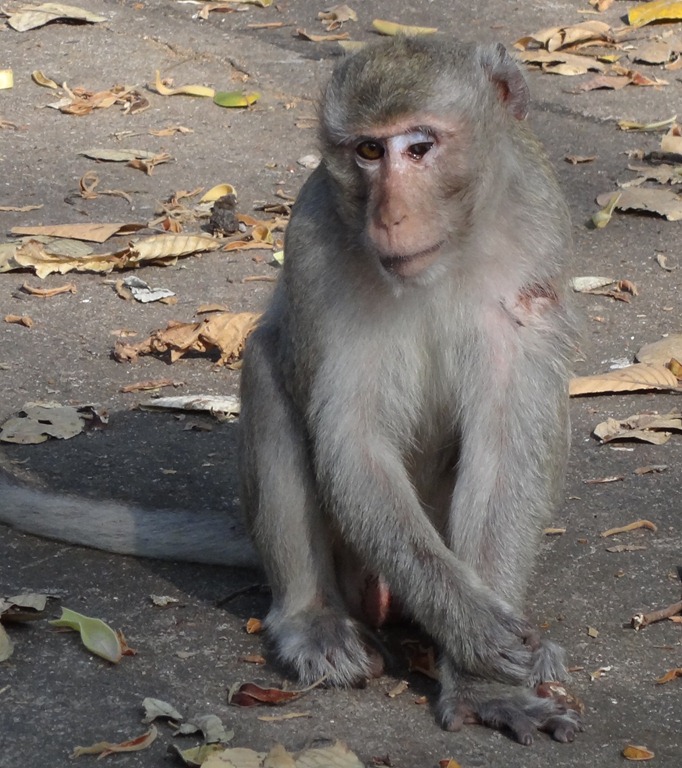
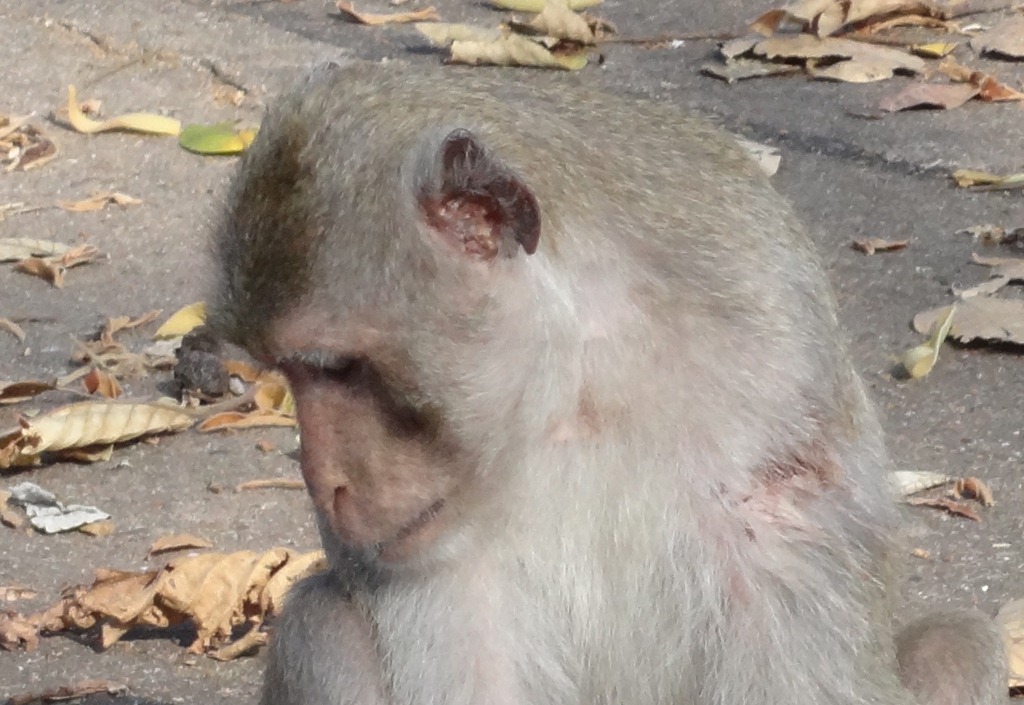
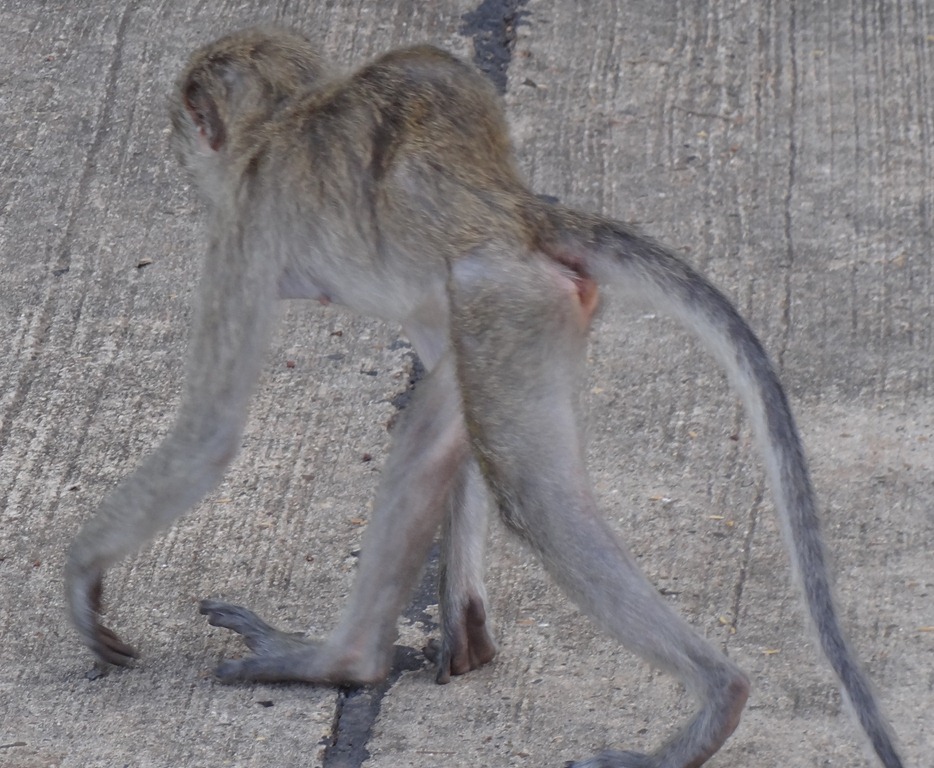
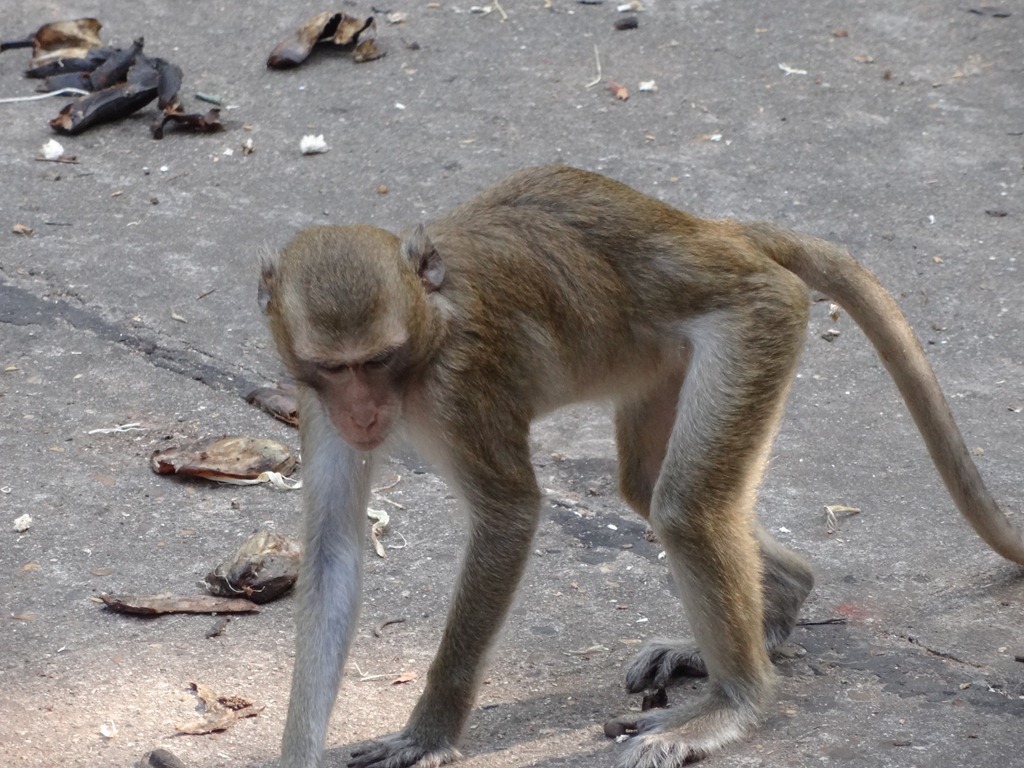
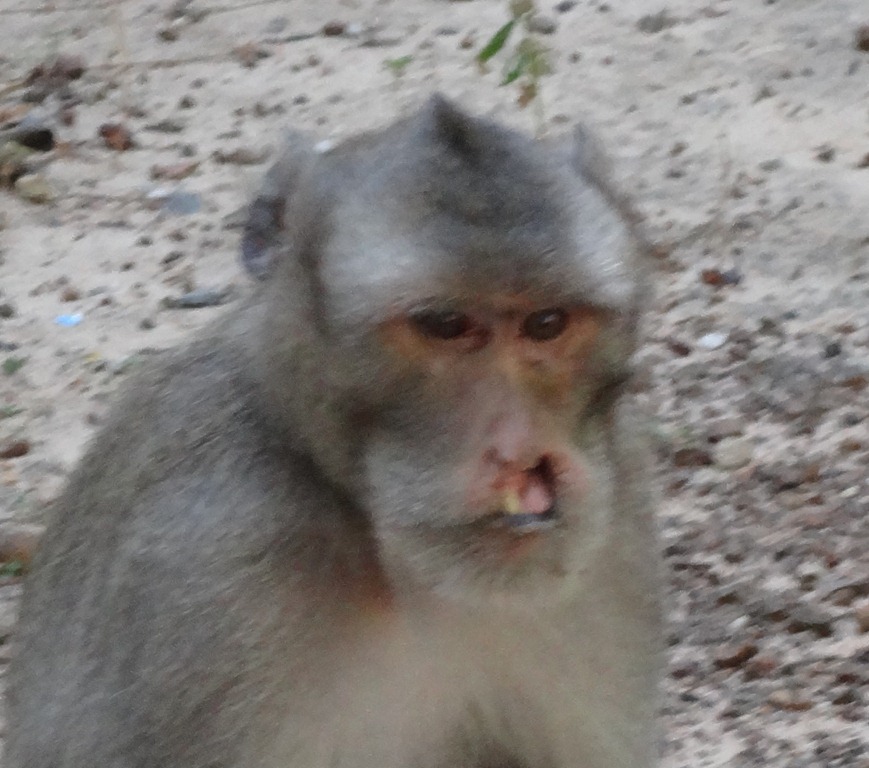
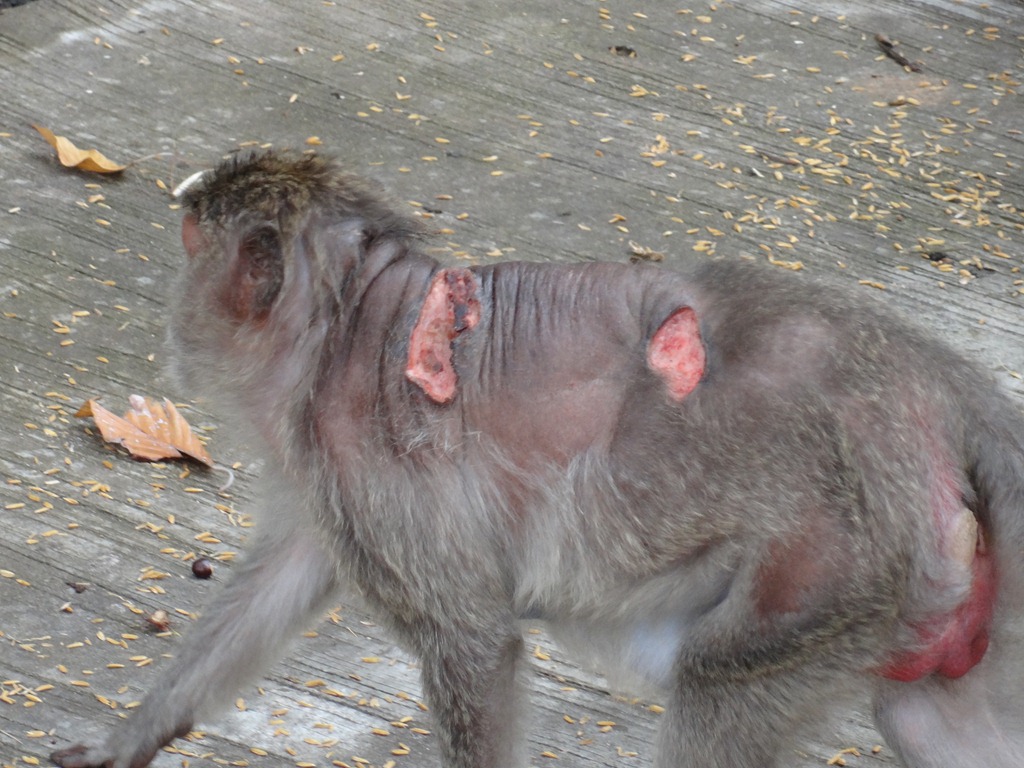
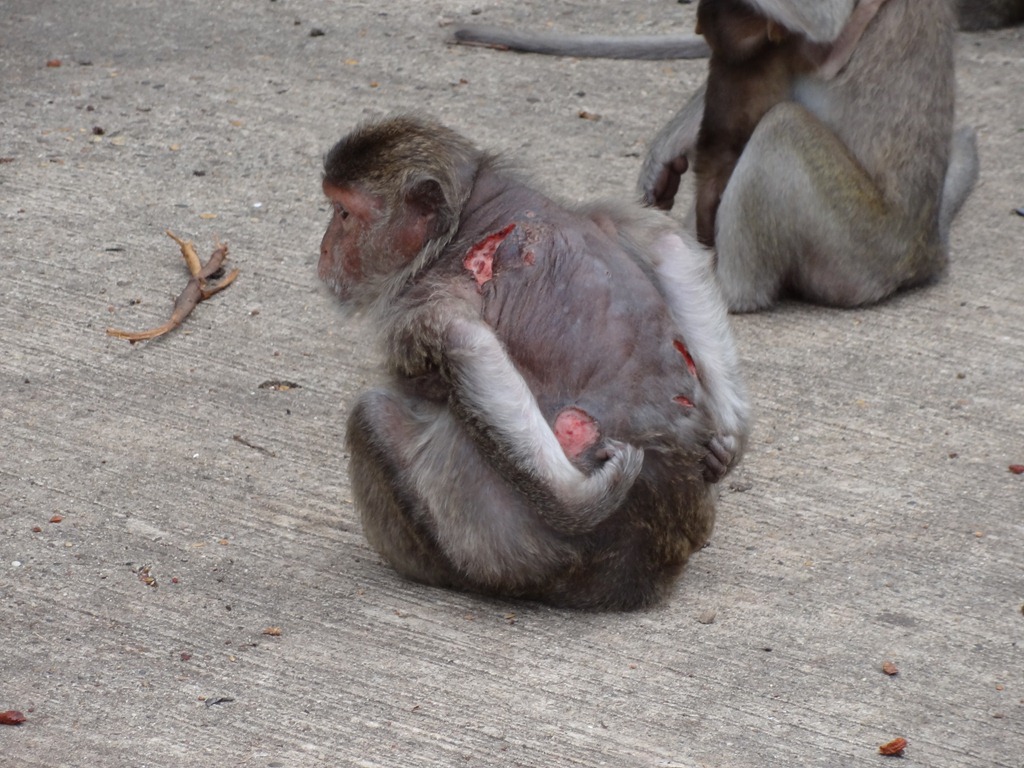
We try to keep a photographic record of injured monkeys. In theory it is much easier to track the movements of such monkeys than to track the far more numerous and difficult to distinguish healthy, unharmed monkeys. In practice, though, we often lose sight of injured monkeys for quite long periods of time and have just about given them up when they reappear. It seems to be the case that our monkeys are able to survive what look like horrendous injuries despite the only treatment they get is self-licking and more grooming and comfort than they would normally receive.

Here I am going to give some of the more extreme examples of injuries we have seen since the start of this year. We are certain that most of them have survived and are now well past the time when infection might set in. Just one case, I think, has probably resulted in a fatality.

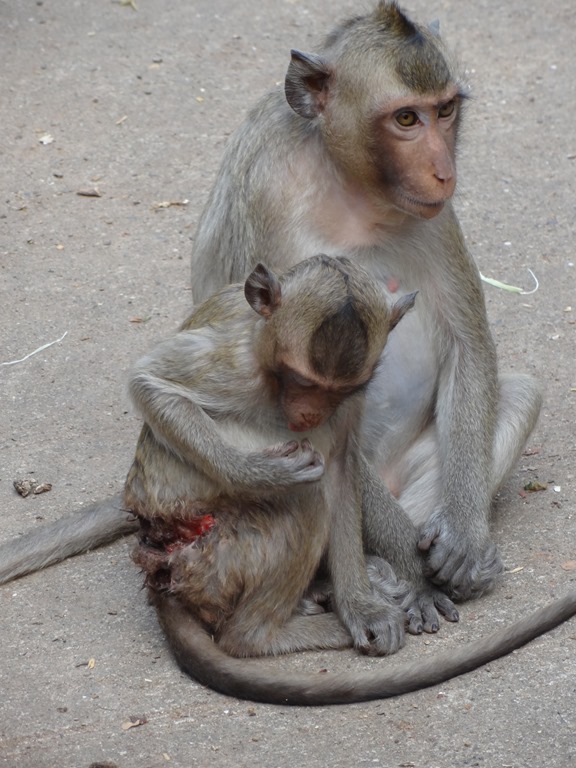
Many of the nastiest injuries have almost certainly been inflicted by a dog and most likely by just one dog. The monkeys are well aware of dogs they can trust and they are usually well aware of strange dogs and the one or two which come into the forest with the intention of hunting. But although they mostly flee into the trees at the approach of the one ‘killer’ dog which makes a frequent appearance in the forest, I have seen them behave somewhat recklessly, leaving their ascent to the very last minute. The injuries which follow are probably the result of just that sort of recklessness.

DSC04210A    DSC06042    DSC06045

The monkey on the left is not the same one as in the centre and right pictures, but the injuries are very similar. They both suggest dog because of their size and position.

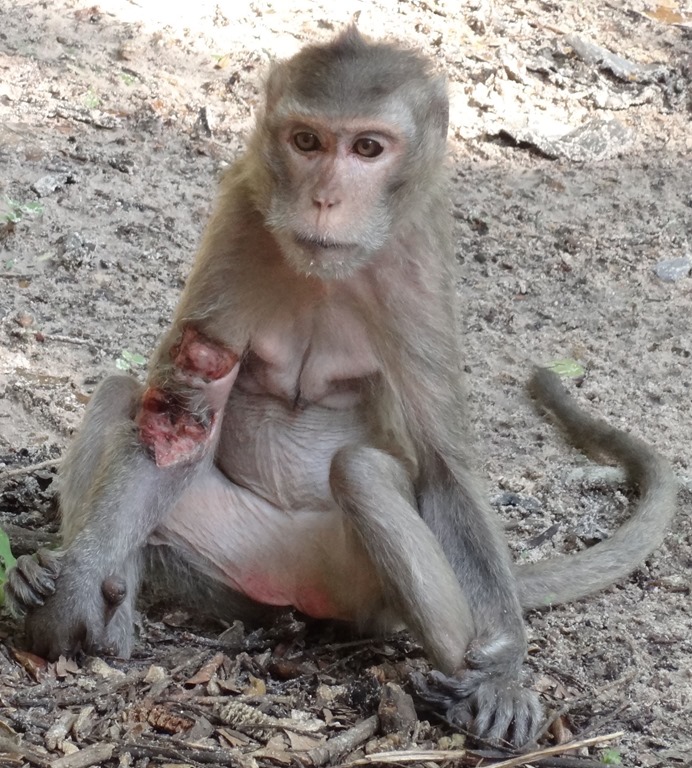
These next two are large wounds but their positions make it unlikely that they were inflicted by a dog.
DSC06779        DSC07169

DSC07121        DSC07122

This monkey, on the other hand, does look as if it was severely savaged, and we remember seeing (but not photographing) him much earlier when the wounds were still raw. We had not expected him to survive and now suspect that despite getting to this stage, he did finally succumb. Of all the injured monkeys I have seen, he is the only one which has seemed to communicate pain, as he was doing in the picture on the left.

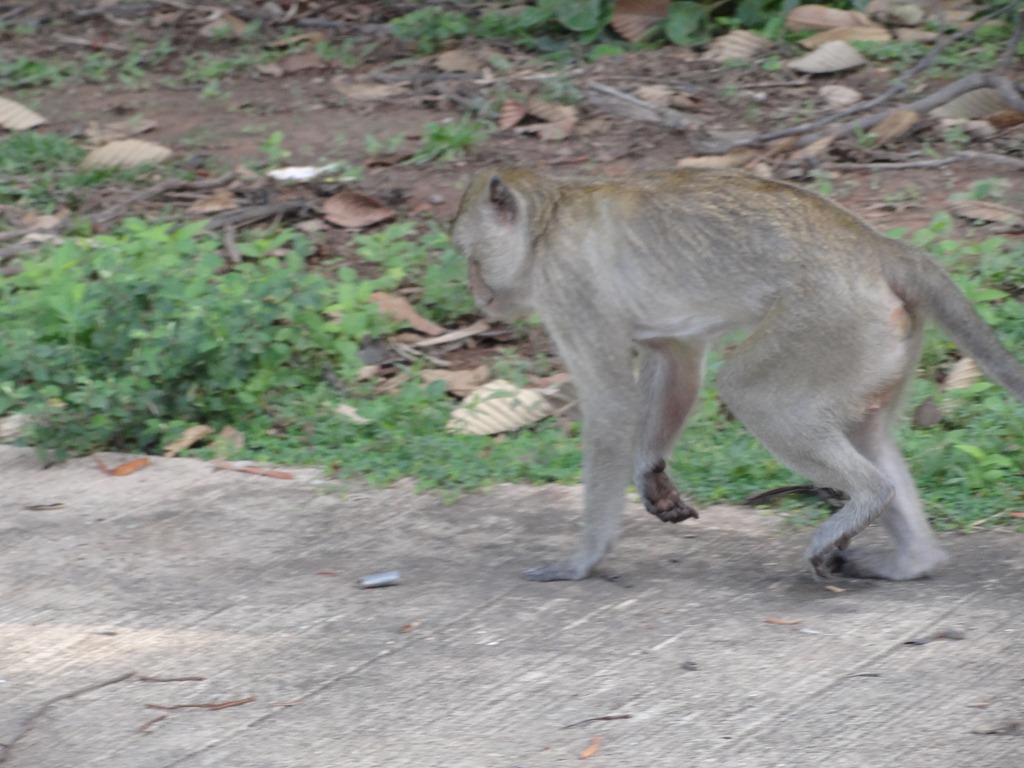
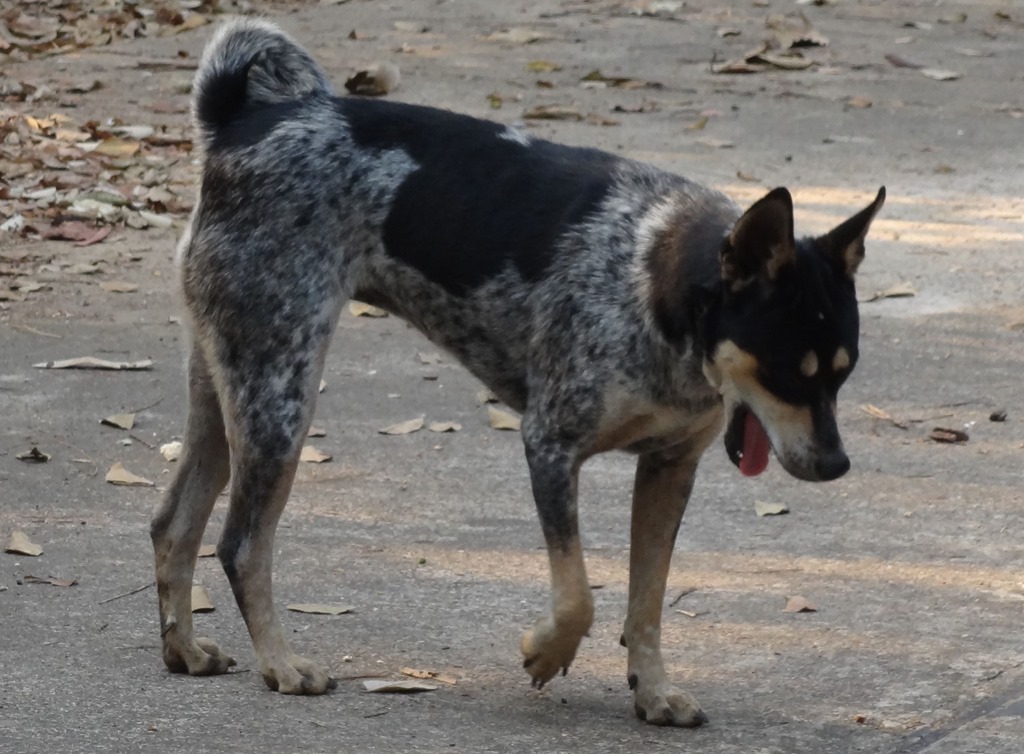
And here is the chief suspect. He runs through the forest fully focussed on spotting a vulnerable monkey, and spreading terror wherever he goes.
DSC05932

Posted in injured monkeys, Long-tailed Macaques, monkey forest, Monkeys, Phana Monkey Project | Tagged , , , , | 2 Comments

Twins born to Long-tailed Macaques in Thailand

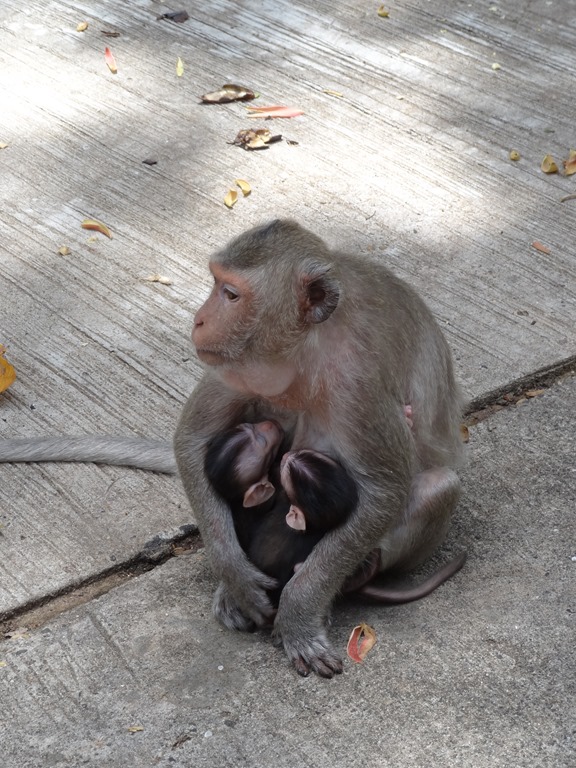
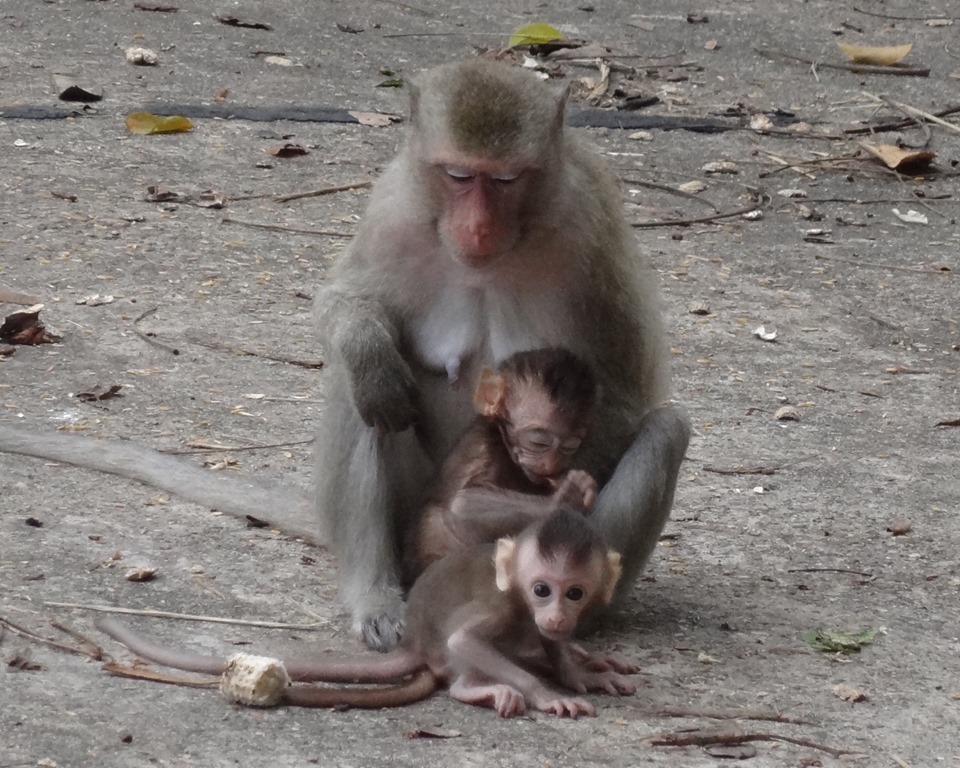
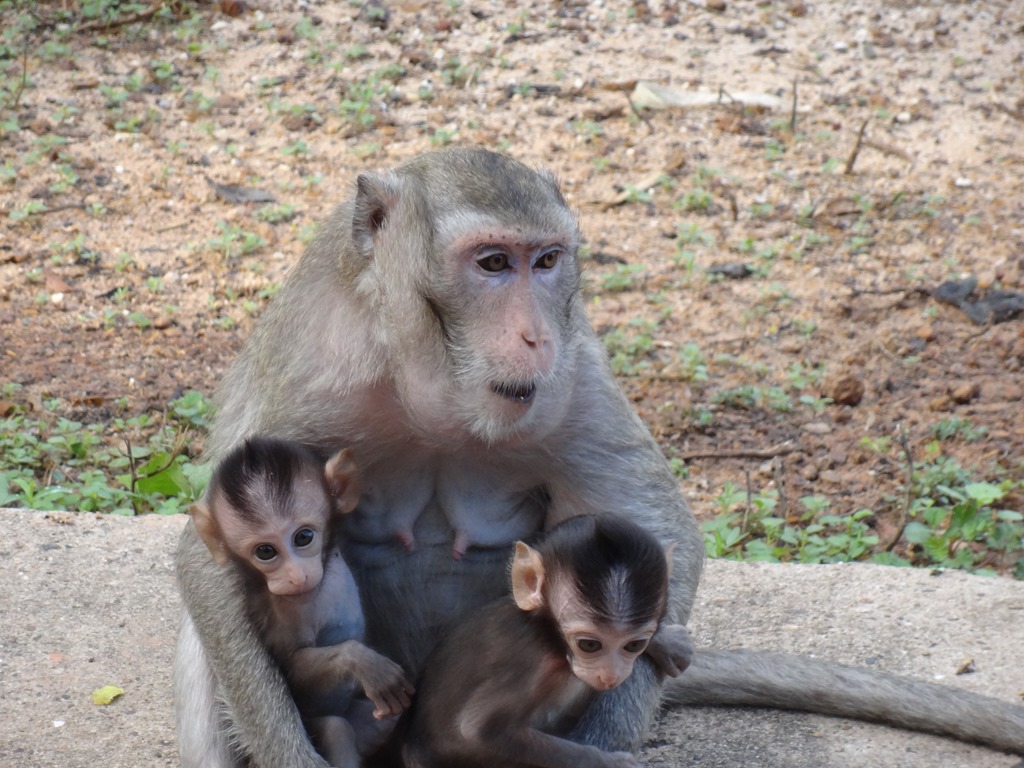
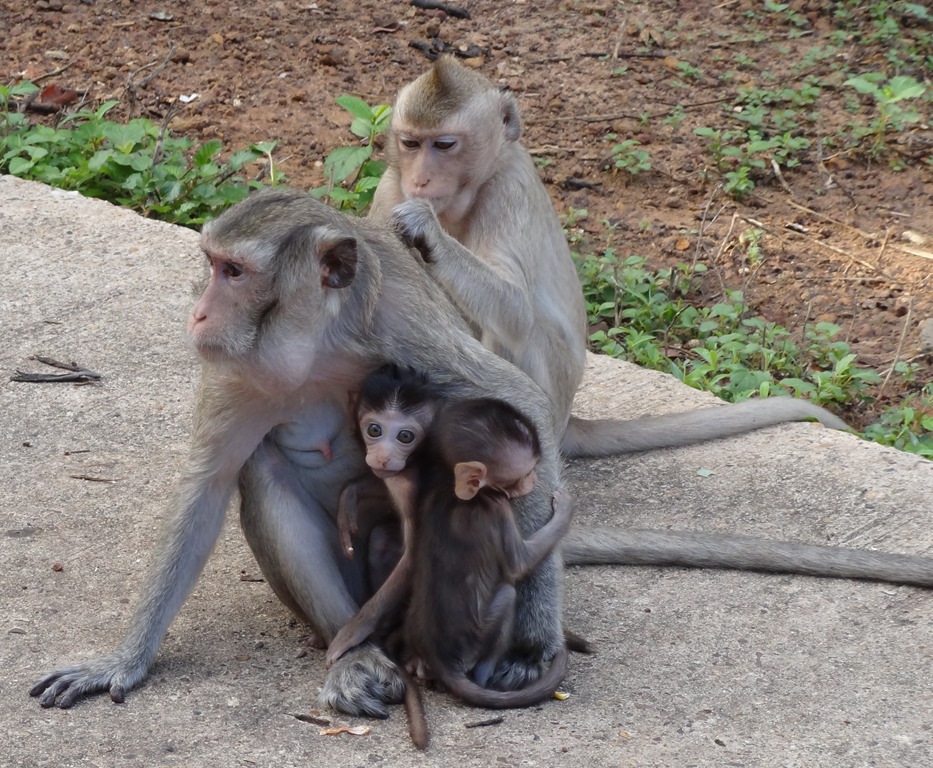
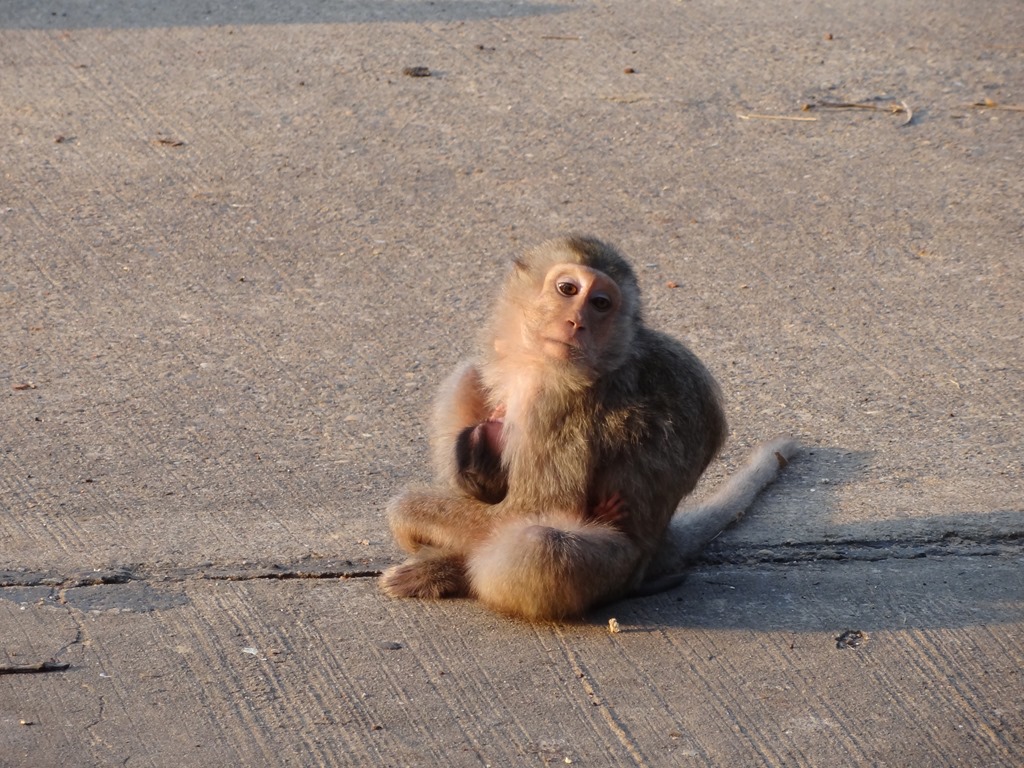
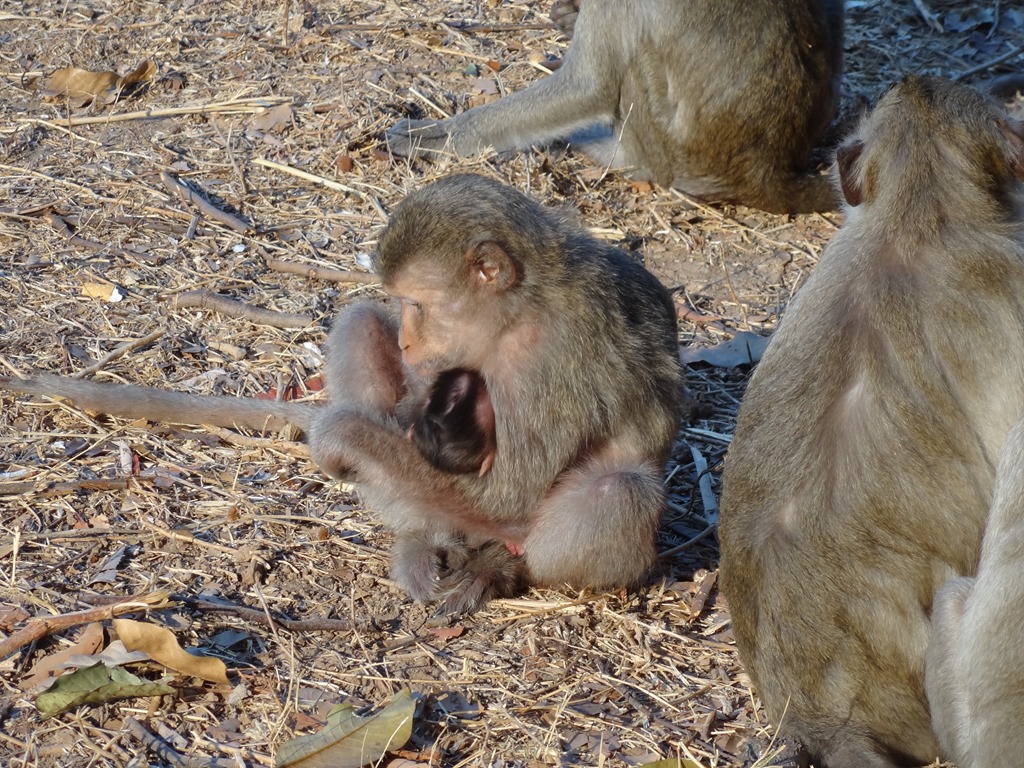
A pair of twins were born in Don Chao Poo Forest last year and once or twice recently I have thought I have  seen them but it is very difficult indeed to distinguish  individual monkeys and particularly so when they are juveniles. This year, at least one pair of twins have been born and it is possible that there are two pairs. Certainly I have seen a mother and a pair of infants in two locations which are usually frequented by monkeys from two different troops.

In addition to the difficulty of clearly identifying the mother, another complication is that infants are often ‘borrowed’ by other members of the family group, and at times are watched over by others in the group – a sort of baby-sitting service – and this is most obvious when twins are concerned.

Here are some photos of the twins I see most often and almost always in the same location.

DSC06940   DSC06941  DSC06945DSC06947                 DSC06784DSC06728    DSC06638  DSC06646    DSC06650

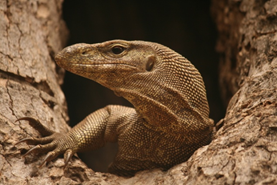
The pair of monitor lizards has recently returned to the tree they lived in last year. We had been worried that they might have been hunted because they are considered a delicacy and fetch quite a good price in the market. Last year the female gave birth earlier in the year than this, but in the last few days she has been sunning herself and it is apparent that it won’t be long before she gives birth again.

DSC06937      DSC06938

Posted in Long-tailed Macaques, Macaca Fascicularis, Macaques, Monitor lizards, Monkeys, Phana Monkey Project | Tagged , , , , | Leave a comment

More forest fauna

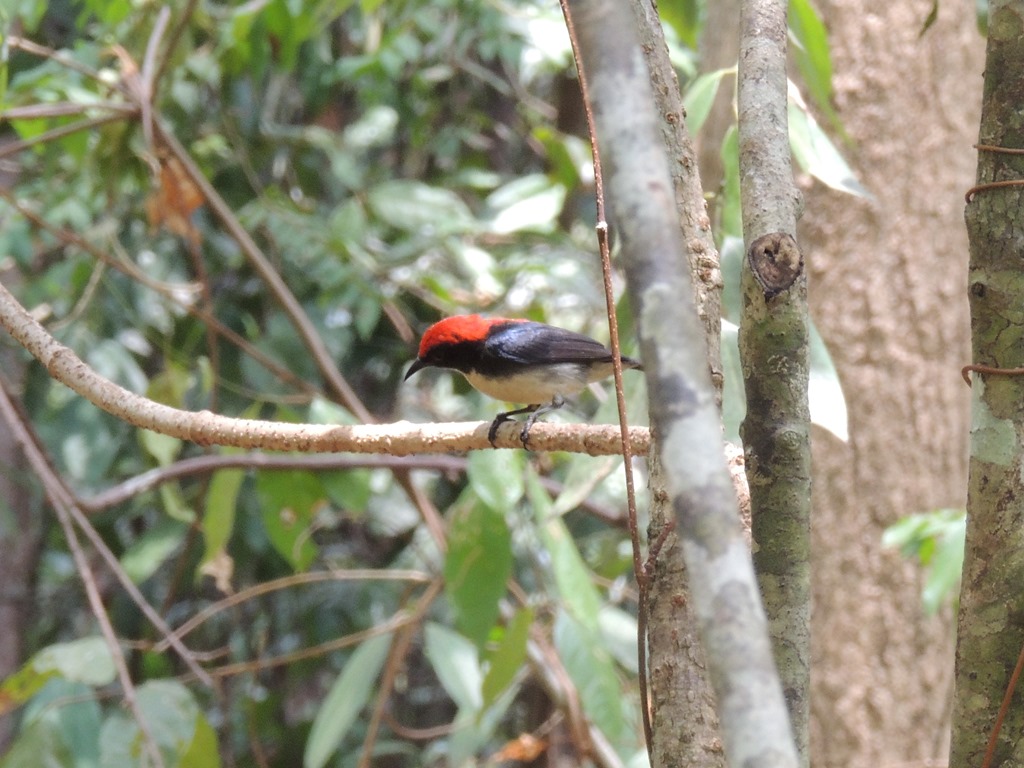
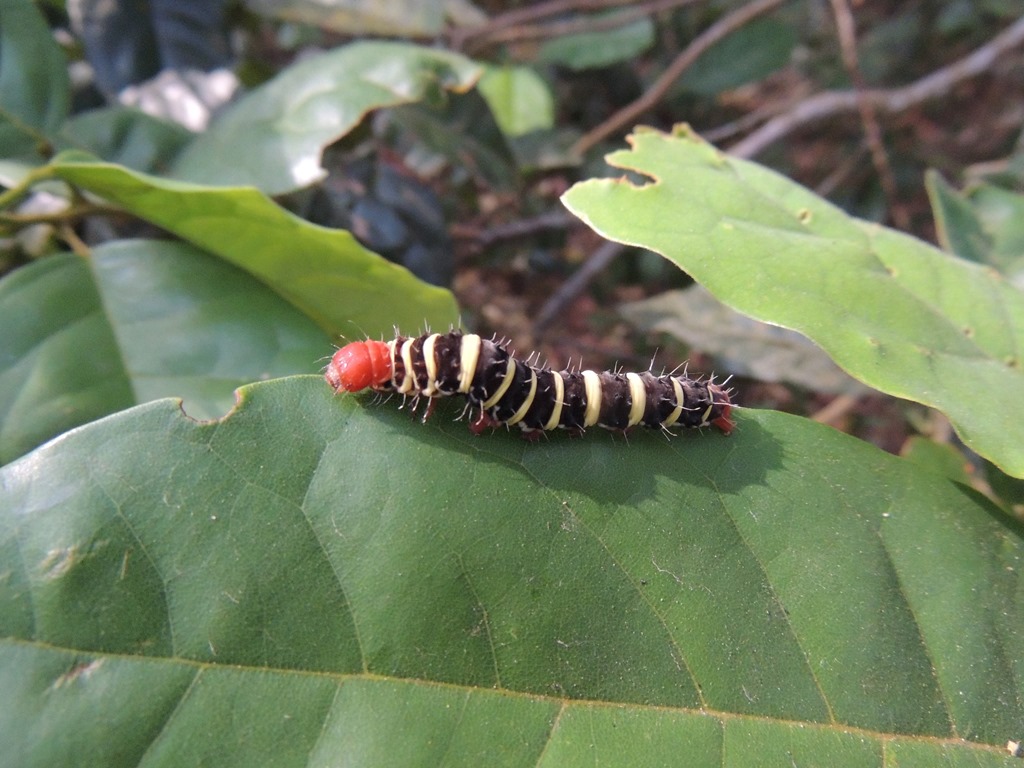
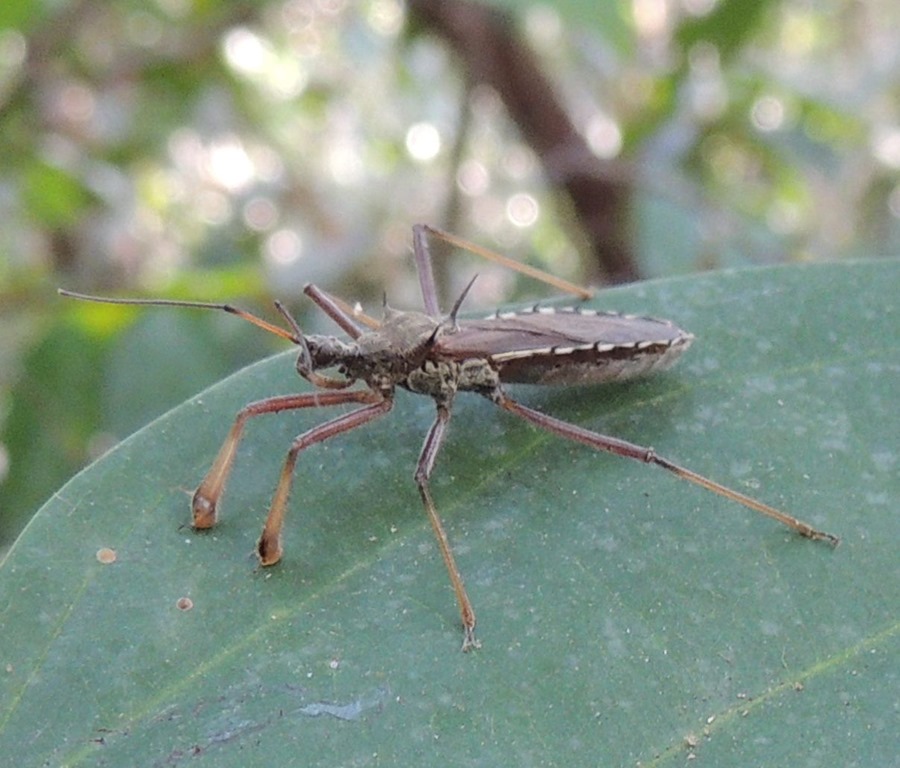
Elizabeth has produced some more striking photographs of forest fauna. We are awaiting confirmed identification but in the meantime, enjoy the photos!

DSCN3222        DSCN32162013-02-15 12.39.11

DSCN3082        DSCN3158

Posted in Bio-diversity, monkey forest, wildlife photography | Tagged , , , | 2 Comments

Newly discovered fauna in the Monkey Forest

Using the term ‘Monkey Forest’ in this post may be misleading because what I am celebrating here is species that have not previously featured on this website and which we were unaware even existed in the forest.

There are a couple of exceptions to that, however. We knew we had Monitor Lizards but had not seen them for several months. Now one large adult has reappeared and two younger, smaller specimens. This picture is of one of the younger ones, showing off a bit, I think.

DSC06186

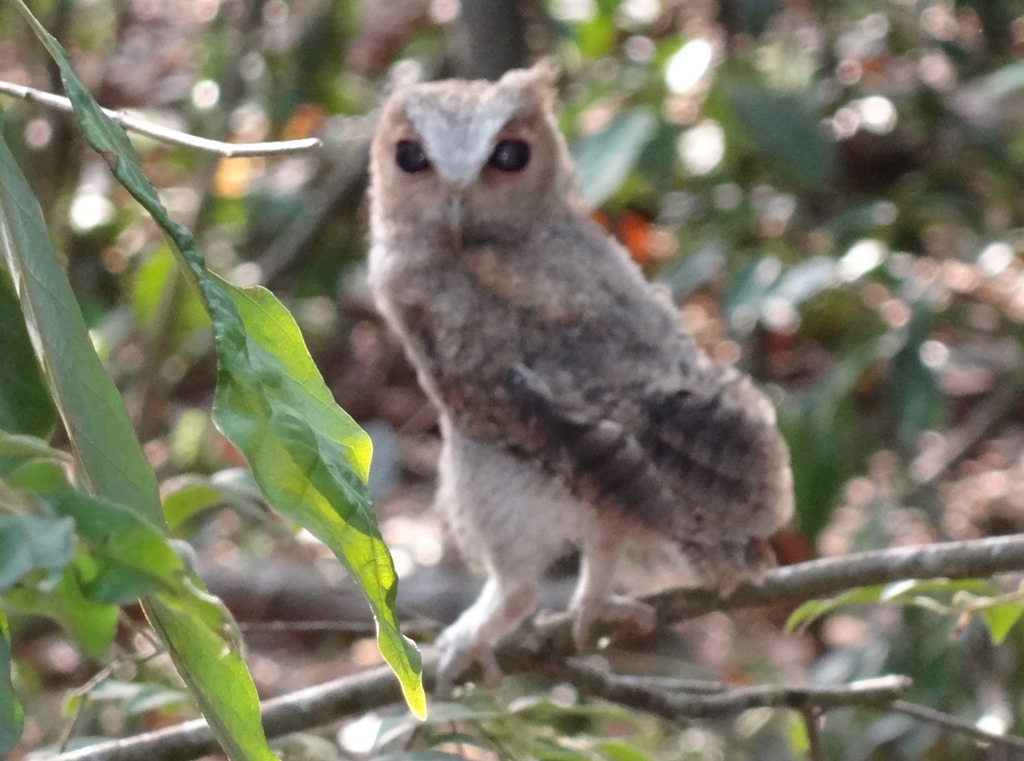
And the next two pictures are of a fledgling owl that I saw for the first time this morning. I have heard owls in the forest at dusk and later, and have thought I saw one, but this one flew straight towards me at about 8 am and, exhausted by its early flying efforts, I think, sat on this slender branch until a monkey came along and shook it off.

DSC06452      DSC06457

The next four pictures, though, are of species we did not know inhabited the forest, but the fact that they do comes as not much of a surprise.

554945_10151382326411935_252757102_n[1]             P3130164

61560_10151382324891935_651706935_n[1]             537280_10151382330191935_1046637522_n[1]

Thanks to Rebekah for the toad (frog?) and Elizabeth for the other three.

Posted in Bio-diversity, Monitor lizards, monkey forest, wildlife photography | Tagged , , , , | 2 Comments

A VERY Happy Valentine’s Day in Don Chao Poo Forest

I was almost, but not quite, witness to a very happy event in Don Chao Poo Forest yesterday. I was near the third gate at 6pm watching the troop we call Troop 3 preparing to go to roost in the trees. Most of them had gone already but about 50 remained. Emerging from the undergrowth and sitting on the edge of the little road that runs from our bin to Gate 3 was — little Humpy! I first posted about her HERE last November and then on 12 December I was proud to announce HER PREGNANCY along with this photo:

Humpy pregnant

So, last night she sat herself down on the roadside, legs even further apart than in the pic above. She seemed unconcerned that I was taking a close interest in her, but I don’t think she had the strength to move away anyway. After a few minutes she was convulsed by what looked like a silent hiccup but was a contraction, I guessed. And then another. Then she lay down. Over the next 15 minutes or so she sat up three times but each time she keeled over again, rather than lay down. Sitting up, she let out little whinnying noises but no other monkey came to her aid; in fact, they seemed to be deliberately ignoring her (unlike me). I supposed that perhaps she was calling out something like “Leave me alone! I’m having a baby!”

The fourth time she got up she moved towards the further side of the road but only made it to the middle. She stayed there for about 5 minutes, by which time there were only two other monkeys which had not gone up into trees for the night. They went, and Humpy slowly made it across the road and into the undergrowth. It was 6.35 pm and fully dark now so I left her to get through the night as best she could.

This morning I was back in the same spot at 7 am and so were about 25 monkeys, but no Humpy. And then at 7.32 I saw her sitting in the middle of the road again. CLUTCHING HER LITTLE BABY! Not very scientific of me, but I almost had a little tear, I was so glad the two of them had made it.

And here they are:

DSC05687DSC05689DSC05692

It was noticeable that she soon found some company, unlike the previous night:

DSC05723

So this is one monkey whose date of birth we will always know. I just hope that the baby is a female and so will stay with her mother.

Posted in Long-tailed Macaques, Macaca Fascicularis | Tagged , , | 2 Comments

Helping to keep the forest clean

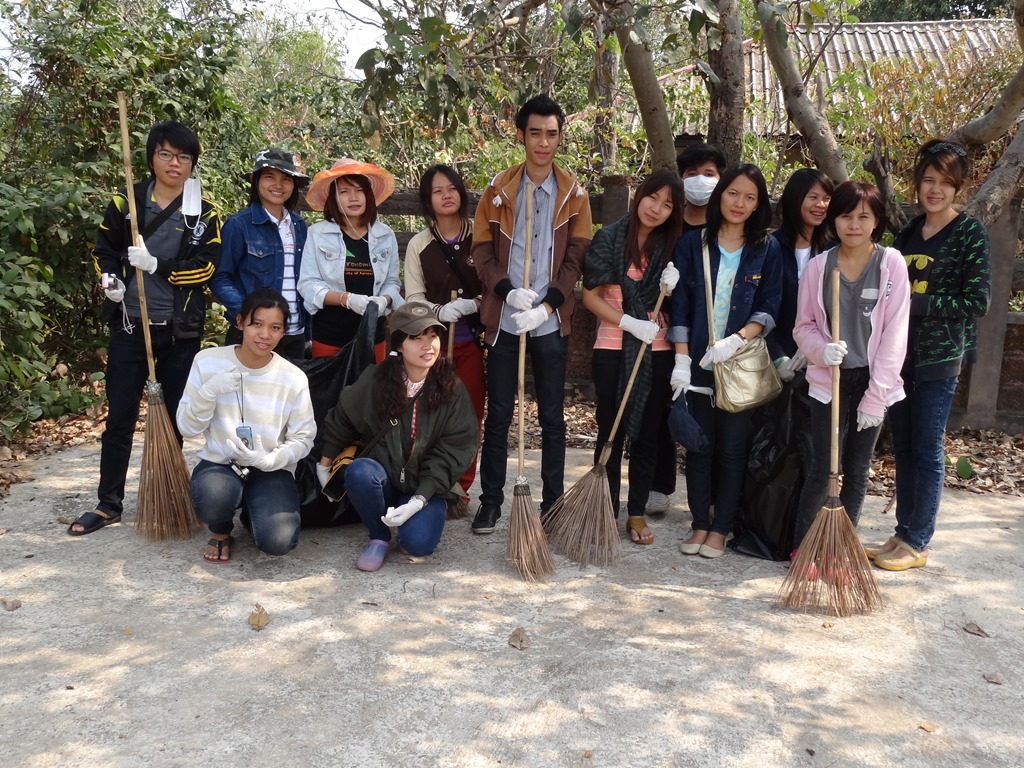
This morning we were visited by a group of fourteen 4th year students from Ubon Ratchathani University. They are in the Agriculture Department but they came as part of their ‘Environmental Awareness’ programme. With their help we cleared the front of the forest of all the plastic bags left by visitors yesterday, a day when a lot of people came to feed the monkeys.

DSC05337 DSC05338 DSC05339DSC05340 DSC05342

They also visited our exhibition to learn about the long-tailed macaques.

DSC05331 DSC05332   DSC05334

Their help was really appreciated and we hope that they will be the first of many such visitors.

Posted in Litter, Long-tailed Macaques, monkey forest | Tagged , , | Leave a comment

Reporting a pregnancy

Pregnancies are all too common among the population of long-tailed macaques in Don Chao Poo Forest, Phana. But today I spotted a young female whose pregnancy we have been waiting for. She is the monkey with a severe curvature of the spine that I mentioned HERE. As I mentioned in that post there are one or two other females with a similar condition, though less severe. What we are hoping to find out is whether this female will produce offspring with or without the condition. We shall have to wait and see.

DSC05053     DSC05056

Posted in Long-tailed Macaques, Macaca Fascicularis, Macaques, Monkeys, Research | Tagged , , , , , | Leave a comment

Juvenile macaque fatality

This morning I came across a dead monkey in the undergrowth only a metre from the surfaced road that runs through Don Chao Poo Forest, Phana. It was a young male, not much more than an infant, so perhaps about two years old. He was lying on his stomach, limbs splayed out and with head turned towards one side. There was a considerable amount of sand on his fur, suggesting that he had been dragged to that location. There was no visible cause of death and nor was there when I later removed him and made a cursory examination of the body. A road traffic accident would have left some visible sign such as blood or damage to the skull but there was neither. He was well fed, and fur in good condition, so it seems unlikely that he died of disease. My conclusion is that he died an accidental death probably by falling out of a tree.

(At this point I should perhaps make two autobiographical observations: I read a great deal of ‘police procedural’ fiction and it is coming in unexpectedly  useful.  Secondly, I have often thought it surprising that more young males don’t come to a bad end as a result of their dangerous-looking play in trees: I almost want to say “I told you that was dangerous”.)

When I discovered the body of this young monkey I was picking up litter in the undergrowth. There were perhaps 50 – 60 monkeys on the road nearby, all within about 20 metres of me. None of them took any notice of me, but then they never do because they know me well, and know that I am not going to feed them or cause them any harm. I  spent some time looking at the body, photographing it, moving around it. None of the monkeys took any notice of me that I was aware of, although an infant in a low tree overlooking the spot did make some small noises. The other monkeys, however, did not respond to these noises.

I went away to fetch a bag and returned about ten minutes later. There were fewer monkeys on the scene when I returned and I became aware that the two nearest, perhaps just 2 metres from the body, were adults, a youngish male grooming a female who was sitting up and facing the spot where the body was lying. They watched me going back into the undergrowth but stayed where they were.

I put the dead young monkey into my bag and left. As I went away I looked back and saw that the male had left the female and was headed into the undergrowth to the spot where I had found the body. So this pair of monkeys were more than bystanders and suddenly I became aware that I had intervened in their grieving pro.

I felt some guilt but had taken the body because it is very rare to come across one and the last I had found disappeared after I had been monitoring it for several days. That body had been slowly stripped of fur, the flesh eaten away, and then all the bones disappeared except one rear leg which had snagged in some nearby branches. A complete, undamaged skeleton would be very useful for our exhibition so I don’t really regret taking it. What I do regret is that I intruded on the grieving pair and didn’t just sit myself down at a distance and observe their behaviour. If I had recognised them for what they were, I would have done so.

Posted in Long-tailed Macaques, Macaca Fascicularis, Macaques, monkey forest, Monkeys | Tagged , , , , | Leave a comment

Tracking injured monkeys

Tracking individual monkeys gives us a clearer idea of their habits and the extent of their range. That’s the theory, but in fact it is very difficult to distinguish between one monkey and another. A few individuals do stand out but amongst 700 or so monkeys it can often be several weeks between sightings of any such individual.

Easier to recognize are those monkeys which are carrying injuries, and unfortunately there are a number of these, so getting a sighting of at least one of them on any given day is fairly certain.

The easiest of our monkeys to spot is this one, which has no tail.

B0000088

He seems to live the usual social life,  mating with several females and often found shepherding young males, presumably his offspring. He frequents two main areas: along the wall north of the main gate, and in the open area just inside the main gate during much of the day. There is another male which has only half a tail and that seems fairly certainly the result of a traffic accident, but whether the same is true of this one I don’t know. I don’t see the monkey with the half-lethngth tail very often and have no photo of him.

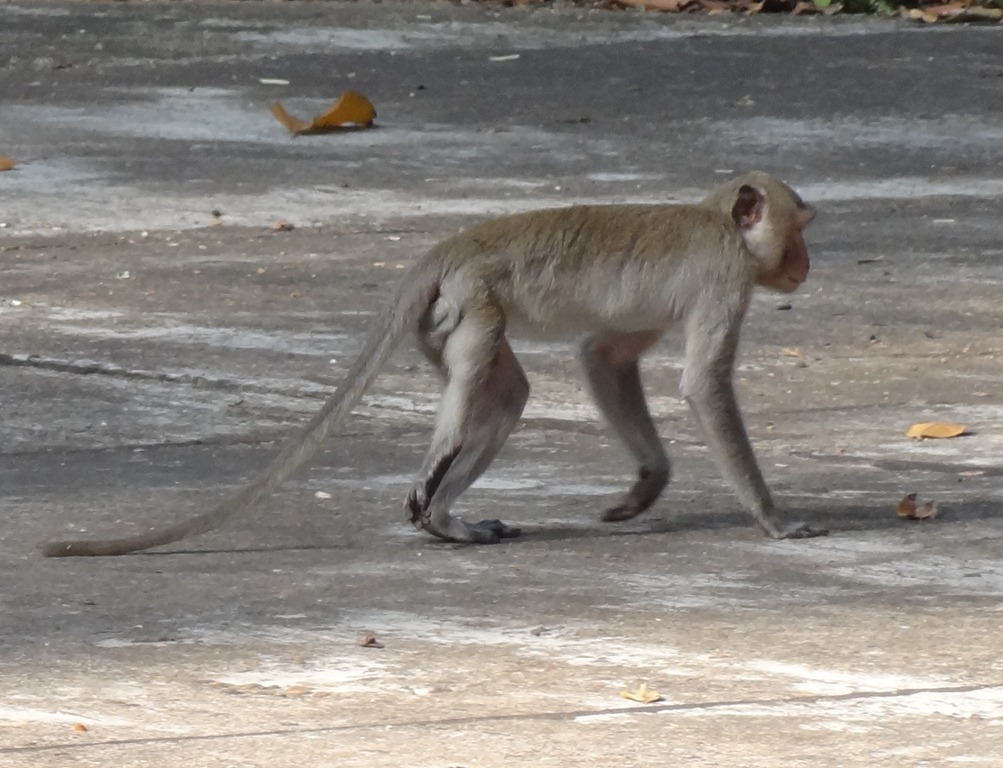
Traffic accidents are almost certainly the cause of the most frequently-seen injury. At present there are four or five monkeys moving along on the ground using just three legs. Most often it is just the foot which has been rendered unusable, presumably by a vehicle running over it.

DSC03010          DSC04372_edited-1

          injury to front right paw      injury to front left paw

Injuries to the eye are also quite frequent and are most likely the result of fighting, although slingshots cannot be ruled out as a possible cause. This male is one I see most days, and one of the conclusions I draw from that is that his use of the forest is confined to one particular area.

eye injury 1    eye injury 2

This next monkey has an injury to his right eye and some damage to his ear and shoulder – all of which indicates his recent involvement in a fight.

DSC04614  DSC04620DSC04616

There are two or possibly three monkeys, all female, which have hump backs. The smaller of the two has the more severe case and it seems possible that her growth has been restricted by the disease causing such severe over-curvature of the spine.

DSC03012   DSC03013

This is the second female. Her spine is affected further towards the tail and the deformity is much less pronounced. Both the two monkeys  are sometimes found in the area just inside the main gate, although the smaller of the two is more often to be seen near the pond area further south. I have never seen the two of them together so their being of the same family can almost certainly be ruled out.

DSC04405

Most of the injuries I have seen our monkeys carrying do not seem to be life-threatening. But two monkeys, at least, do not seem to have survived. The first was a large male that I saw just once, in November 2011. He was with a group of all-male juveniles and seemed to be their guardian, while they were eating the rice grain we provided, anyway. His injuries were severe and probably received in a fight, but he was eating and appeared to be generally in good health.

B0000123_edited-1    B0000124

Yet I never saw him again, though he would have been instantly recognisable. I can only think that perhaps he left the troop or that infection in his wounds caused his death.

A female that I came across in June this year had a very severe case of what looks like sarcoptic mange. She had lost a lot of hair from her back and the exposed skin looked very leathery. She was constantly scratching herself and this may have caused the open wounds. She was eating undisturbed by other monkeys but did not seem to be part of any group. She sat and ate and walked alone. I saw her several times over the course of a week or so, but have never seen her since. I can’t believe that she recovered though.

 04 July 2012 046      2555-06-25 02-34-45_0003

Posted in Long-tailed Macaques, Macaca Fascicularis, Macaques, monkey forest, Monkeys | Tagged , , , | 1 Comment

Diary of a butterfly hunter

Diary of a butterfly hunter (The Don Chao Poo Forest research continues):

Contributed by Elliot Capp

After my time at ZSL London Zoo working in Butterfly Paradise I developed quite an affinity for butterflies and moths, and one of my first impressions as I walked around the sacred Don Chao Poo forest was of the vast number of butterflies and varying species that were present. As an avid biological photographer, I had come prepared for such an eventuality. From this moment onwards I tasked myself with trying to get photographs of as many butterfly species in the forest as was possible during my time there, in order to be able to identify them and create a visual identification display for the new research centre.

image

Figure 1: The Common Crow (Euploea core)

Throughout the three months that I spent carrying out research in the forest, whenever I got some spare time, I would head into the forest with my camera looking for some unsuspecting butterflies to photograph. I had photographed butterflies in the past and I was well aware of how skittish they can be when you are trying to get a photo of them, and numerous times I had walked away with either an empty shot, or a very colourful blur. So with this in mind every time I headed into the forest with the phrase ‘patience is a virtue’ ringing in my mind.

So tip-toeing amongst the leaves looking for my first targets, I re-discovered just how sensitive these little creatures really are. As soon as I approached them, hundreds of butterflies would burst into the air, quite spectacularly, and disappear. On my first few visits to the forest on my butterfly hunting trips I was successful with a couple of species – quite repeatedly. These were the species that turned out to occur most frequently within the forest and seemed least sensitive to disturbance. I started seeing more and more species, and noting down when and where I had seen them and what they were doing (sitting/flying around particular plants/speeding past), to enhance my chances of getting a useful shot of them.

image

Figure 2: The Archduke (male) – (Lexias dirtea)

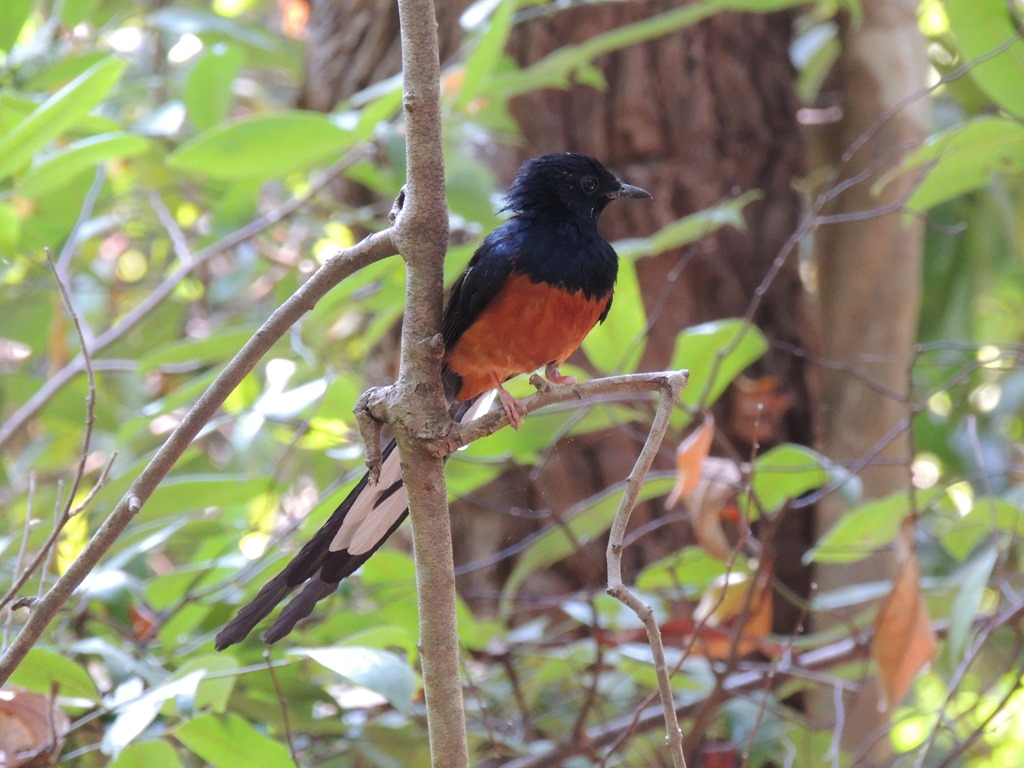
After a few more visits, frequenting the places that I had noted down hives of butterfly activity I started getting a lot more success, even if I did have to sit in silence for a good few hours to get the photos. For the few species that I had not so far managed to get any pictures of, other than a very attractive, however indiscernible blur on my screen, I tried to think of a few tricks to attach them, such as putting sugar water or fruit juice on the floor. Although this was very successful in attracting vast quantities of ants, no butterflies were enticed by my trickery. My sessions of sitting and waiting also proved productive for photographing an elusive bird species (White Rumped Shama) and a Monitor Lizard.

imageFigure 3: White Rumped Shama (Copsychus malabaricus)

image

Figure 4: Monitor Lizard (Varanus bengalensis) in its nest

So how did my little side project pan out over the course of my three months attempting to establish a photographical biodiversity study of butterfly species present in the forest? All-in-all I am very satisfied with the photographs that I managed to get. There are some species that remained elusive to me, that I did not manage to identify, such as the large black and yellow butterfly that only seemed to fly amongst the upper canopy. However, this does provide something for future researchers to try and achieve. I hope that the butterfly display at the new research centre will encourage people to learn about the biodiversity present in their village.

So what was learnt from this photographical butterfly hunt? – Always have your camera ready, keep your eyes peeled, and yes, patience is indeed a virtue.

image

Figure 5: Blue Tiger Butterfly (Danaus limniace)

Posted in Bio-diversity, Butterflies, Monitor lizards, monkey forest, Research, wildlife photography | Tagged , , , , | Leave a comment